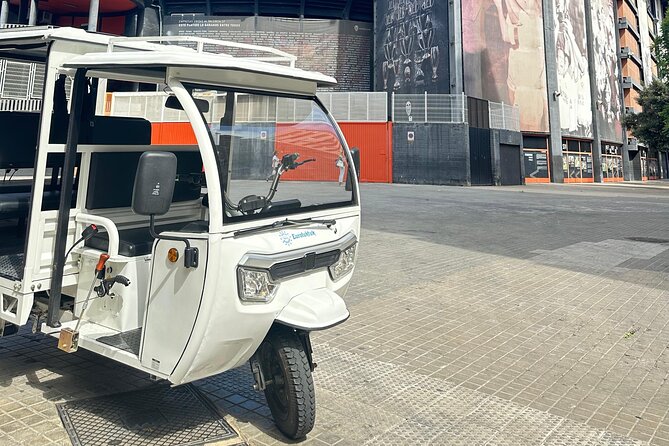
Valencia is spread out, but this tour makes it feel walkable. You ride an open-air tuk tuk between medieval walls, the port, beaches, and the City of Arts and Sciences in about 1–2 hours.
I love the quick-hit route that covers a lot of ground without feeling rushed on foot, especially if your time is tight. I also like that you’ll get multilingual guiding with English available, so the stops mean something rather than just looking pretty. One thing to consider: because the ride is open-air and mostly street-level, you may not get perfect views of upper details or rooftops.
In This Review
- Key things to know before you ride
- Why a tuk tuk tour fits Valencia so well
- The Medieval Walls Route: Serrano Towers and Quart Towers
- Sea Gate: the Civil War memorial twist
- Turia Gardens bridge timing: when flowers matter
- Mestalla stadium views without the long detour
- Old Port and Veles e Vents: modern Valencia by water
- Beaches in two flavors: Malvarrosa and Las Arenas
- City of Arts and Sciences: fast, dramatic, and worth seeing
- Markets and architecture stops: Central Market and the “shopping-meets-gourmet” vibe
- Bullring and Estación del Norte: two icons that feel different
- Price and what your money buys in 1–2 hours
- Timing, visibility, and the reality of open-air touring
- Who this tour is best for (and who should skip it)
- Should you book this Valencia tuk tuk tour?
- FAQ
- How long is the Valencia tuk tuk tour?
- What does the tour cost?
- Is the tour offered in English?
- What’s included in the price?
- Are tips included?
- Where does the tour start and end?
- How many people are on the tour?
- Do I need a mobile ticket?
- Are service animals allowed?
- How far in advance do people usually book?
- Is free cancellation available?
Key things to know before you ride
- Up to 12 people total keeps it small enough to feel personal.
- Bottled water included (one bottle per person), handy in Valencia heat.
- English guidance available, plus other languages via the guide team.
- Serrano Towers are climbable and even let you explore the interior before you move on.
- The Turia bridge is seasonal: flowers change every four months, with another switch coming in September.
- The open-air tuk tuk helps you reach corners buses can’t, which is great for short stops and photos.
Why a tuk tuk tour fits Valencia so well
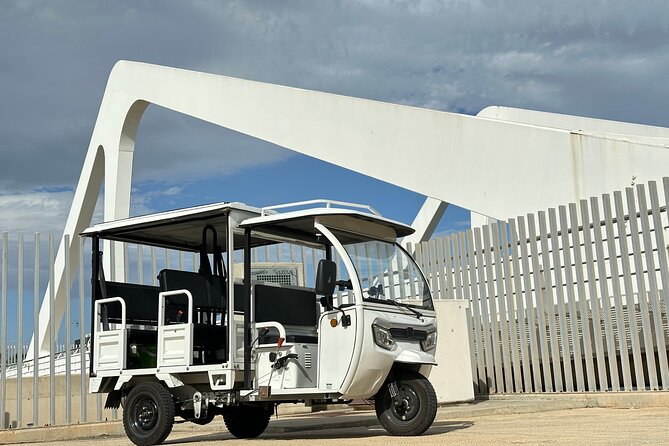
Valencia can be both easy and tricky. The city center is compact, but the big “wow” sights stretch outward: the arts-and-science complex, the beaches, and the port. A tuk tuk tour is a smart middle ground when you want variety in a hurry.
This one is priced like an activity, not a full-day tour, and the value comes from pacing. You’re not stuck in one neighborhood. Instead, the route jumps between eras and settings, so you leave with a map in your head: old city gates, modern architecture, water, sand, and markets.
You can also read our reviews of more tours and experiences in Valencia.



The Medieval Walls Route: Serrano Towers and Quart Towers
The tour starts by working your way through Valencia’s medieval defenses. The Serrano Towers are the first big anchor. They were built between 1392 and 1398 as part of the city walls, designed by Pere Balaguer. You’ll see the two polygonal towers framing a central arch, with a fortress-like exterior that reflects its defensive purpose.
What makes this stop especially worthwhile is that you can explore the interior and climb for one of the best views of the city. Even if you only get a short climb window, it changes the whole experience. Looking down on Valencia turns what you saw at street level into a real layout, with the old walls you’ve been hearing about suddenly making sense.
Later, you’ll come back to the defensive story with the Quart Towers, built between 1441 and 1460 along the road connecting Valencia toward the west and north. They’re brick with Gothic elements, and the shape is unmistakably “gate-and-wall” thinking: robust towers linked by a wall and a big arch. They suffered damage during the War of Independence and were restored in the 19th century, so they carry both medieval design and later repairs in their structure.
If you like architecture more than sightseeing checklists, this “walls” section is one of the best parts of the ride.
Sea Gate: the Civil War memorial twist
Not everything on the route is medieval. The Sea Gate sounds ancient, but it’s actually a modern reconstruction: rebuilt in 1946 to honor those who fell in the Spanish Civil War. It’s made of white stone with three arches, with the center arch the largest.
This stop works because it adds emotional context without turning the tour heavy or long. You’re still moving. You just get a meaningful landmark that ties Valencia’s coastal identity to 20th-century memory.
It’s also a useful transition. After the towers, the port and waterfront stops start to feel less random and more like a single story: city walls protecting the city, then the sea and trade shaping it.
Turia Gardens bridge timing: when flowers matter
One of the most interesting “small moment” stops is the bridge over the Turia Gardens, opened in 2002. It was designed as an extra step across the gardens, and there’s a fun local detail: every four months, the flowers change.
If you care about photos that look current, this is the kind of stop where timing helps. The information you’re given notes that September is when flowers change again, and it calls out that the “worst month” for seeing them as expected is that period. Practically, that means: if you’re traveling near that switch, don’t expect the same floral look you might have seen online.
This stop is quick, but it’s a good reminder that the tour isn’t just about monuments. It also nudges you to notice how the city changes with seasons.
Mestalla stadium views without the long detour
Next comes Mestalla, home of Valencia CF. The tour calls it one of Spain’s emblematic stadiums, designed by Santiago Calatrava, with seating for about 50,000. Even if you’re not a football fanatic, it’s a useful stop because it’s a landmark you’ll recognize later in photos and in the city’s skyline.
What you get here is the “sense of place” effect. The stadium doesn’t need a deep visit to register. From the tuk tuk route, you see how modern Valencia anchors itself next to older districts and major infrastructure.




Old Port and Veles e Vents: modern Valencia by water
Then you shift to the water: the old port of Valencia covers about a million square meters and is full of activity. The tour frames it as a mix of culture, innovation, business, and leisure, with sports and arts happening alongside food and music.
A standout reference here is Veles e Vents, known for distinctive architecture. It hosts exhibitions, dance events, and different arts programs. The tour also mentions the Tinglados and the old shipyard, plus the idea that the port supports a lot of boating activity with hundreds of private moorings and services for sailing, diving, and kayaking.
This isn’t just “look at boats.” It’s Valencia showing you its working-with-the-water side, not only the postcard beach side.
Beaches in two flavors: Malvarrosa and Las Arenas
Valencia’s beaches are a big part of why people stay longer than planned. This route includes two distinct beach areas, and that’s a smart move because they don’t feel identical.
First is Valencia’s most famous beach, identified as the area that shifted from a flower area to the beach people recognize today in the middle of the 19th century. Expect wide, fine golden sand and easy access from the city.
Then you go to the other shoreline stop tied to an older neighborhood identity: the beach named from Valencia’s old fishing quarter. Locals still call it Las Arenas, linked to an old spa that now operates as a luxury hotel complex.
The practical part here is you get a sense of what beach life is like: restaurants and entertainment, plus the idea that some spots become nightlife zones. One named example is Marina Beach Club.
If you’re traveling in summer, these beach stops are a relief valve. You get a break from dense streets without spending hours walking.
City of Arts and Sciences: fast, dramatic, and worth seeing

You’ll end up at the City of Arts and Sciences, one of Valencia’s most recognizable architectural statements. Construction is described as starting in 1996 and ending in 2009, with the goal of revitalizing the city into a worldwide cultural, scientific, and leisure hub.
Design-wise, it’s attributed to Santiago Calatrava and Félix Candela. That matters because the place feels engineered and artistic at the same time: bold shapes, clean lines, and a layout that makes you want to look up even when you’re on a short stop.
This stop is where the tuk tuk approach really pays off. On foot, you could spend a whole day just getting there and navigating around it. From the tour route, you get the big external impressions and enough context to know why it’s so famous.
Markets and architecture stops: Central Market and the “shopping-meets-gourmet” vibe
Valencia is great for food culture, and the tour makes sure you’re not only looking at sights. You’ll pass two market-style landmarks.
First, there’s a modernist building opened in 1928, designed by Francisco Mora as part of a project to modernize commerce and revitalize the city center. It’s described with colorful mosaics, ornate columns, and a large glass dome. It was renovated in 2003 so it became a space with restaurants, cafes, and gourmet options. Even if you don’t stop long, you can feel the shift from “trade” to “eat and meet.”
Then comes the Central Market of Valencia, opened in 1928 and described as one of Spain’s oldest and most vibrant markets. It has modernist architecture with a large iron-and-glass dome, plus colorful ceramics and ornamental details. It’s also positioned close to other major landmarks, including La Lonja and Plaza del Ayuntamiento.
This segment is useful if you like to eat well but don’t want to plan a full food crawl. By seeing the market buildings up close, you’ll be able to choose your own lunch later with better instincts.
Bullring and Estación del Norte: two icons that feel different
The route includes two landmarks that bookend Valencia’s public-life feel: sport and transit.
The Bullring, opened in 1859, is described as neoclassical and one of Spain’s emblematic arenas. It seats about 10,000 and features a circular brick structure with Doric columns, inspired by the Roman Colosseum. Even though it’s known for bullfighting, the tour notes it now hosts cultural events and concerts—so the building still works as a gathering space.
Then comes Estación del Norte, opened in 1917. It’s a modernist station built to modernize and expand Valencia’s railway infrastructure, designed by Demetrio Ribes. Expect colorful ceramics, Valencian-style tiles, and ornamental details. The waiting area and lobby are described as elegant and even reminiscent of the Harry Potter movies, which is the kind of comparison that helps you picture the feeling even before you arrive.
If you’re the kind of person who loves buildings with personality, these two stops are a nice change of pace after towers and beaches.
Price and what your money buys in 1–2 hours
At $32.44 per person for about 1–2 hours, you’re paying for speed, access, and guidance rather than entrance tickets to every site. The tour includes one bottled water per person, which sounds small but is actually practical.
The biggest value is not the number of stops. It’s the logistics. A tuk tuk route helps you connect distant areas efficiently, and the guides explain what you’re seeing as you pass. Names like Tony, Silvio, Salvador, Sebastian, Francisco, and Christian show up in guide feedback for friendliness and helpful storytelling, plus photo tips and patience when something throws off timing.
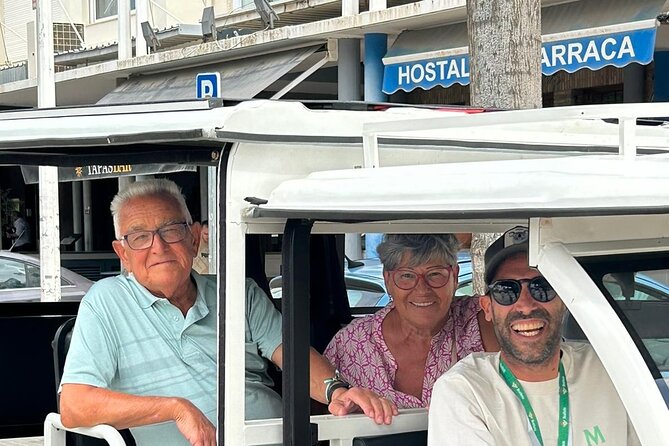
One more value note: you’re capped at 12 travelers, and each tuk tuk can split small groups (one review response referenced 4 people per vehicle). That typically means you get less “herding” energy than with big bus tours.
Timing, visibility, and the reality of open-air touring
This is an open-air experience, so you’re not in a climate-controlled bubble. In hotter months, that changes what you notice. Bring sun protection, and if you can choose your start time, you’ll likely be happier with a morning or late-afternoon slot.
Visibility can also be a factor. Because the design is open but not always an uninterrupted line of sight, some people report it can be harder to see upper details than you’d expect. Road noise is another real-world issue; traffic can make it tough to hear the guide at certain moments.
The good news is this: if you’re using the ride as an overview and letting the guide point out what matters, you’ll still get a lot. The tour is built to help you understand the city’s big landmarks quickly, not to replace a slow walking day.
Who this tour is best for (and who should skip it)
This is a great fit if you:
- Have a short Valencia stay and want the fast “greatest hits” map
- Prefer less walking but still want guided context
- Like mixing architectural highlights with water-and-beach scenery
- Want a small group option and a guide who helps you make sense of what you’re seeing
You might want to choose a different style of tour if:
- You strongly prefer deep, time-consuming visits where you can stop and wander freely
- You’re very sensitive to noise or need consistently clear views for high façades and rooftops
- Your schedule is extremely tight (because tour length is listed as 1–2 hours, timing can vary)
Should you book this Valencia tuk tuk tour?
I’d book it if you want an easy way to connect Valencia’s old walls, modern architecture, and waterfront without building a complicated itinerary. For the price, you get a lot of big landmarks in a small amount of time, plus included water and a guide who’s there to explain the “why” behind the sights.
If you’re the type who wants perfect “look up and see everything” photos, or you hate the idea of street noise, you may feel slightly limited by the open-air format. In that case, balance it with a second day of slower walking in the neighborhoods you like most.
FAQ
How long is the Valencia tuk tuk tour?
The tour duration is listed as about 1 to 2 hours.
What does the tour cost?
The price is $32.44 per person.
Is the tour offered in English?
Yes. English is available.
What’s included in the price?
Bottled water is included (one bottle per person). A guide is also included, with multiple language options.
Are tips included?
No, tips are not included.
Where does the tour start and end?
It starts at C. de la Blanqueria, 3, Ciutat Vella, 46003 València, and ends back at the same meeting point.
How many people are on the tour?
The tour has a maximum of 12 travelers.
Do I need a mobile ticket?
Yes. The tour uses a mobile ticket.
Are service animals allowed?
Service animals are allowed.
How far in advance do people usually book?
On average, it’s booked about 26 days in advance.
Is free cancellation available?
Yes, you can cancel up to 24 hours in advance for a full refund.