REVIEW · LANZAROTE
Lanzarote: César Manrique Full-Day Tour
Book on GetYourGuide →Operated by Low Cost Tours Europe · Bookable on GetYourGuide
Manrique made a desert look artistic. This full-day tour strings together Mirador del Río and Jameos del Agua, showing how César Manrique fused architecture with the island’s volcanic reality. I also love how the stops build a story, from rural life at the Monumento al Campesino to his own artistic home at the Fundación. One thing to plan for: it’s an 8–9 hour day with lots of pickups, so you’ll want to accept that time is tight at each location.
You’re paying about $100 per person for a guided, air-conditioned bus day with entrances included (lunch isn’t). It’s a strong value if you want the key Manrique sites without figuring out north Lanzarote on your own. Just don’t book it if you hate moving around, stair-heavy places, or confined cave settings.
In This Review
- Key highlights that make this day work
- Why César Manrique’s Lanzarote still feels different
- Getting there: 8–9 hours, and why pickups can feel like the real tour
- Casa Museo y Monumento al Campesino: starting with the people
- Mirador del Río and the Valley of a Thousand Palms
- Jameos del Agua: a lava tube turned into a living venue
- Jardin de Cactus: 1,100 species in 5,000 square meters
- Fundación César Manrique: his former residence as the real museum
- Lunch on this tour: plan for an extra meal stop
- Price and value: is $100 a good deal?
- Who this tour is perfect for (and who should skip)
- Should you book the Lanzarote César Manrique full-day tour?
- FAQ
- How long is the Lanzarote César Manrique full-day tour?
- What is included in the tour price?
- Is lunch included?
- What are the pickup and drop-off arrangements?
- Does this tour include cave areas?
- What languages are the live guided tour available in?
- Is this tour suitable for wheelchair users or people with mobility impairments?
Key highlights that make this day work
- Manrique’s art-to-architecture-to-nature loop across multiple iconic sites
- Mirador del Río viewpoints where the view and the building are part of the same idea
- Jameos del Agua’s lava-tube world with a small lake and white-blind crabs
- Cactus Garden at Jardin de Cactus with 1,100 plant species over 5,000 square meters
- Fundación César Manrique in his former residence, where the creative process feels tangible
- Guides who handle multiple languages, with clear site explanations and timing
Why César Manrique’s Lanzarote still feels different

Lanzarote can look simple from far away: lava fields, bright sky, and wind that seems to have its own opinion. César Manrique’s genius was to treat that raw environment as the starting point, not the problem. This tour is worth your day because it shows Manrique’s “rule” in real places: architecture shaped by nature, and nature protected through design.
Two things I’d call the best parts. First, the way the day balances dramatic view moments with human-scale artistic details. Second, the variety: a rural monument and museum, a viewpoint, a lava-tube cave, a cactus garden, then Manrique’s own home. You don’t just see objects. You see his thinking.
If you’re expecting a slow, wander-at-will day, this isn’t that. Even with breaks, it’s built as a tight loop—so come with curiosity, not a need for unlimited time.
A few more Lanzarote tours and experiences worth a look

Getting there: 8–9 hours, and why pickups can feel like the real tour
The tour runs about 8–9 hours, and that time includes round-trip transport. You’ll board an air-conditioned bus, and because there are many pickup options, the morning can involve several stops before you truly head out.
Here’s how to make it easier on yourself:
- Choose the closest pickup point to your accommodation from the long list provided.
- Confirm your exact pickup details in advance (the operator asks you to message with the exact point and time). If you don’t, you may get a standard assigned pickup farther away.
- Be at the meeting place early. Late arrivals don’t get rerouted or refunded.
The tradeoff is clear: the route is efficient for the company and good value for you, but it can mean a slower start. Once you’re moving, the pacing is generally described as organized and not overly rushed at each site—but you still shouldn’t plan to linger for hours.
Casa Museo y Monumento al Campesino: starting with the people
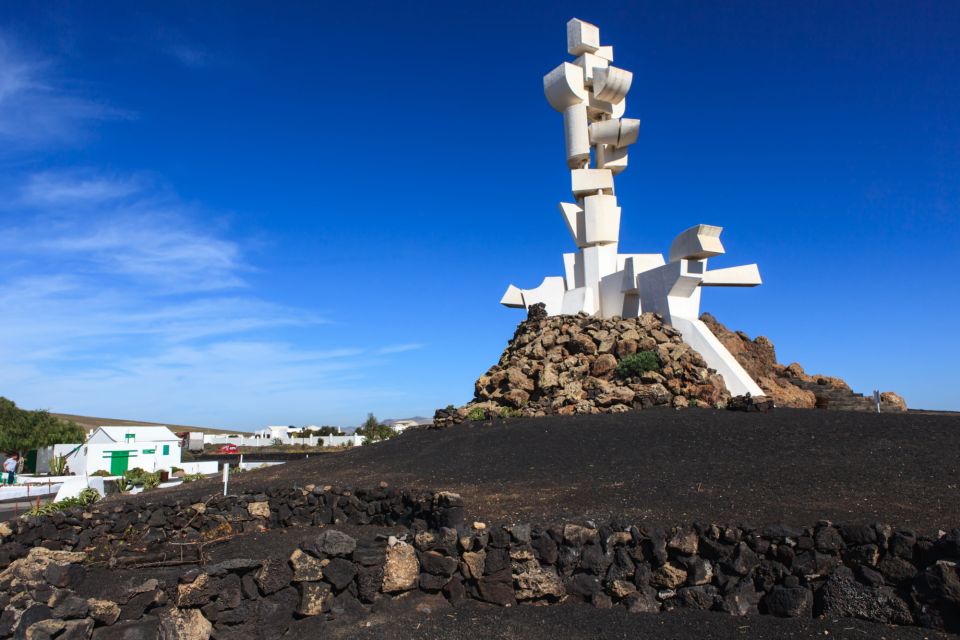
You kick off at the Monumento al Campesino area with a stop at Casa Museo y Monumento al Campesino. It’s a tribute to Lanzarote’s rural workers, and it sets the tone for the day: Manrique didn’t only design showpiece art for visitors. He worked from lived reality—work, landscape survival, and community identity.
This stop also gives you a first taste of how Manrique’s design language can be both functional and artistic. You’ll see a small museum focused on traditional craftsmanship of the Canary Islands, and there’s an impressive restaurant in the foothills of a lava field in the same area.
A practical consideration: this is not just a flat viewpoint. You’re in a site built into volcanic terrain, and that usually means walking on uneven ground and possibly dealing with steps. Some stops later in the day are even more step-heavy, so it’s a good warm-up and a good reason to wear supportive shoes.
Mirador del Río and the Valley of a Thousand Palms
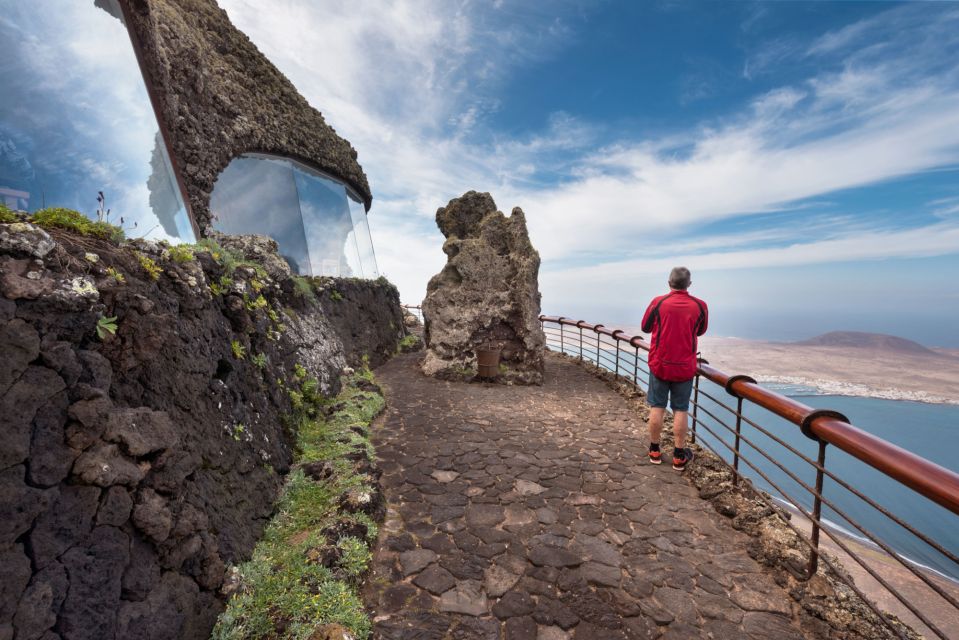
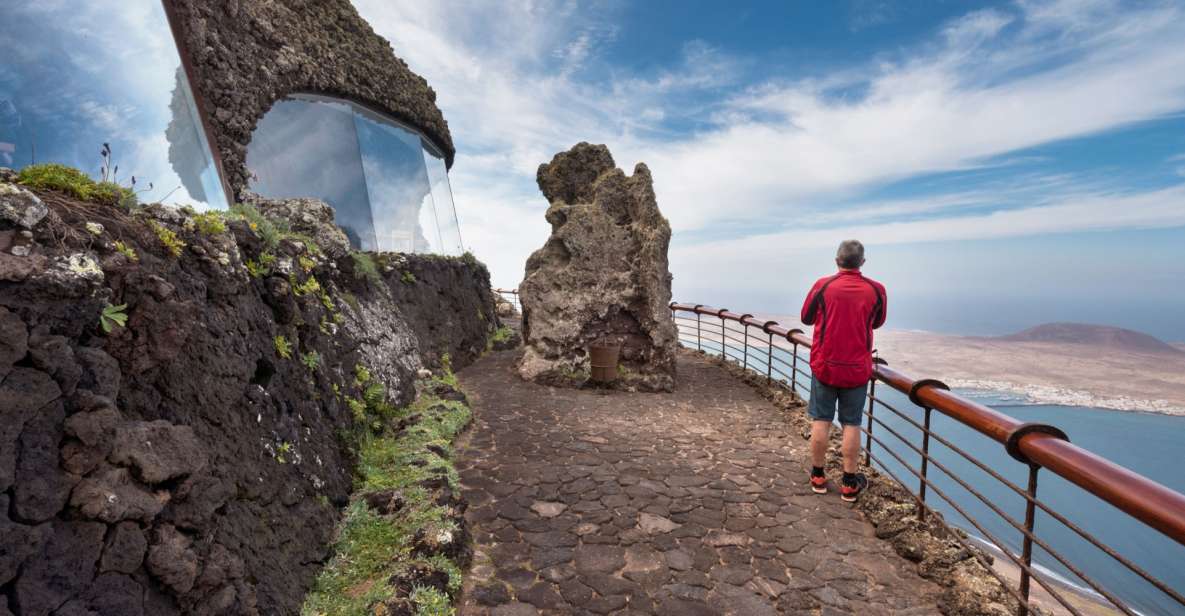
Then you head toward Mirador del Río. On a clear day, this is one of the most dramatic moments of the whole Lanzarote north circuit. The viewpoint is built as a designed experience, not just a place to stand and look.
You also pass through the area connected with the Valley of a Thousand Palms, which adds contrast. It’s a reminder that Lanzarote isn’t only lava. It’s also irrigation choices, human ingenuity, and pockets of cultivated life carved into dry surroundings.
What to expect at Mirador del Río:
- Your stop is time-limited, so move quickly from the bus drop-off to the main viewpoint area.
- If weather moves in, the experience can shift fast. Clouds and mist can swallow the distant view. The tour tends to manage the day in a way that accounts for weather and crowds, but you can still get a lower-visibility version of the same site.
This is one of those places where the architecture matters as much as the view. Manrique’s approach shows up here: the structure frames the horizon instead of fighting it.
Jameos del Agua: a lava tube turned into a living venue
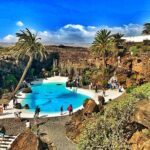
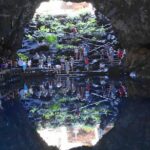
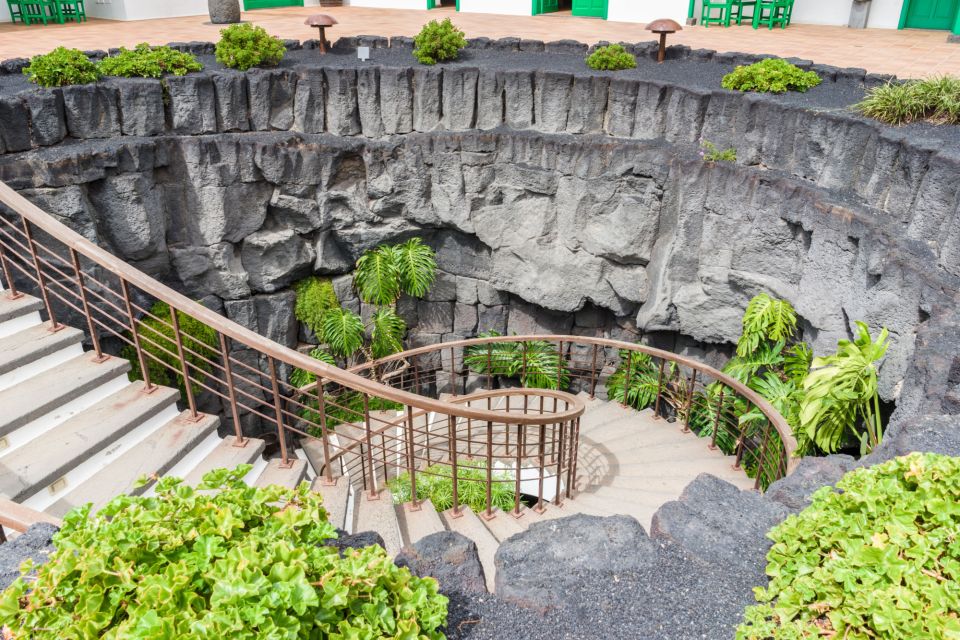
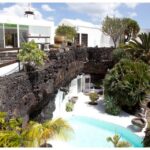
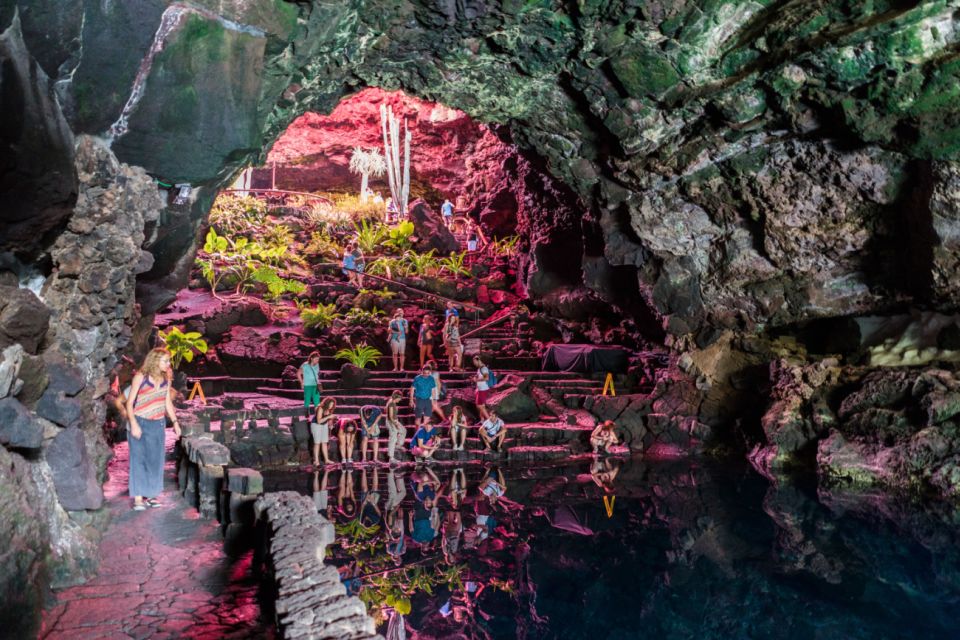
Next comes the star for a lot of people: Jameos del Agua. This place is part of a 7-kilometer-long lava tube formed by an eruption of Monte Corona around 8,000 years ago. So yes, you’re touring a cave. But you’re also walking through a carefully shaped cultural site.
What makes it special:
- You’ll find a small lake with direct access to the sea.
- There’s a concert hall and a restaurant inside the complex.
- You can see the white-blind crabs, adapted to life underground.
Most importantly, it’s not just geology behind glass. The space is arranged so the cave becomes readable: where light falls, where you can pause, where the sea-level connection feels real.
One caution: this is not ideal if you dislike enclosed spaces or have claustrophobia. Cave areas and interior corridors can feel tight, and the site isn’t designed for wheelchair use. Even if you’re comfortable in caves, expect uneven walking and steps.
Timing note: people often appreciate arriving earlier, because it can make the cave feel more open and less crowded. You get about 55 minutes here, which is enough to see the main areas without feeling like you’re doing a sprint.




Jardin de Cactus: 1,100 species in 5,000 square meters
After the lava-tube cave, you switch to a very different Manrique environment: the Jardín de Cactus. The numbers here are impressive for a garden stop: more than 1,100 plant species from around the world spread across 5,000 square meters.
Why this matters on the tour: it gives your brain a visual reset. After geology and architecture inside Jameos del Agua, the cactus garden is about contrast, color, and scale—how Manrique-style design can make dry land look intentional, not abandoned.
What I like about this stop is how it fits into the day’s overall theme. Manrique wasn’t trying to “tame” nature into something else. He was showing how the right environment and layout can let plants thrive while visitors enjoy the space.
This stop still has walking, and it’s a garden with paths rather than a single viewing platform. Wear sun protection (sunglasses and a hat help), and plan to slow down for photos. It’s one of those places where you’ll see something new just by turning a corner.
Fundación César Manrique: his former residence as the real museum
Finish the loop at the Fundación César Manrique, his former residence. This is where you really understand what you’ve been seeing all day. When you step inside a space designed by Manrique for living, you stop thinking of his work as separate landmarks. It starts feeling like one consistent project.
The complex is built into the foothills of one of the island’s longest lava flows, and the structures run through the house. That lava setting changes how you experience the rooms: you’re never far from the island’s volcanic “context,” even when you’re inside.
Inside, you’ll see examples of Manrique’s art and how his work developed through the spaces he created. People often describe this as a highlight, so if you’re balancing your energy, make sure you save your best attention for the Fundación.
A practical tip: this is a site where time feels most valuable. A longer stop here generally means more chance to connect the dots between architecture and art. If you arrive tired, you can miss details that make the place feel unique.
Lunch on this tour: plan for an extra meal stop
Lunch is not included, but there is a designated lunch time. In practice, it’s an optional buffet lunch served during the day in the tour circuit area.
My advice: if you’re sensitive to meal timing, bring a small snack or plan your water intake so you’re not hungry between sites. The day has enough walking that a mid-route meal matters.
Also, because the schedule is tight, don’t count on using lunch time to do extra sightseeing. It’s there to keep you going, not to extend the tour.
Price and value: is $100 a good deal?
For around $100 per person, you get a lot for a full-day experience on Lanzarote north:
- Air-conditioned coach transport
- A live guide
- Entrance fees to Mirador del Río, Jardín de Cactus, Jameos del Agua, and the Fundación César Manrique
- Travel insurance for the tour duration
- Pickup and drop-off at multiple points
Is it worth it? If you want the Manrique highlights without driving, navigating, or lining up for tickets, yes. The included admissions are a big part of the value, and the guide helps connect what you’re seeing so the day feels like a coherent story instead of random stops.
The main “cost” isn’t money. It’s time and stamina. If you’re prone to motion sickness, dislike stairs, or want long free-walk periods, you may feel squeezed by the schedule.
Who this tour is perfect for (and who should skip)
This is a strong match if you:
- Love art that ties directly to how people live with a place
- Want the big César Manrique sites in one day
- Prefer guided context over self-driving your own route
- Enjoy iconic viewpoints paired with design details
I’d think twice if you:
- Have claustrophobia or strong discomfort with enclosed spaces (Jameos del Agua is a cave environment)
- Use a wheelchair or need mobility accommodations (this tour is listed as not suitable)
- Want a flexible slow day with lots of open time at each site
- Get frustrated by multi-stop pickup routes
Also, bring patience for language pacing. Guides handle Spanish, German, and English, and some guests note fast explanations or quick switching among languages depending on the group. If you need slower speech, sit closer to the guide and listen early when directions come in.
Should you book the Lanzarote César Manrique full-day tour?
I’d book it if your goal is to understand why Manrique changed how Lanzarote presents itself—through viewpoint architecture, lava-tube reinvention, and gardens that respect the island’s dryness. The mix of Mirador del Río, Jameos del Agua, Jardin de Cactus, and the Fundación is exactly what makes the day feel satisfying rather than repetitive.
Skip it if your top priority is lots of free time, or if cave interiors make you uneasy. And if you’re going during a period of unpredictable weather, keep expectations flexible for Mirador del Río’s visibility.
If you can handle a structured day, decent walking, and a guided pace, this tour is a practical way to see the Manrique “big picture” without doing logistics yourself.
FAQ
How long is the Lanzarote César Manrique full-day tour?
It runs about 8 to 9 hours, including round-trip transfers.
What is included in the tour price?
The tour includes a guide, air-conditioned bus transport, travel insurance for the tour duration, and entrance to the Monumento al Campesino area, Mirador del Río, Jardín de Cactus, Jameos del Agua, and the Fundación César Manrique.
Is lunch included?
No. Lunch is not included, but there is a lunch stop where an optional meal is available.
What are the pickup and drop-off arrangements?
Pickup and drop-off are offered at many listed locations around Lanzarote. The operator notes that you should confirm the exact pickup point and time after booking; otherwise you may receive a standard pickup assignment.
Does this tour include cave areas?
Yes. Jameos del Agua is a lava-tube cave environment, which is part of why the tour is not recommended for people with claustrophobia.
What languages are the live guided tour available in?
The guide offers live narration in Spanish, German, and English.
Is this tour suitable for wheelchair users or people with mobility impairments?
No. It is listed as not suitable for wheelchair users and people with mobility impairments.

More Full-Day in Lanzarote

More Tours in Lanzarote
- Tour to Timanfaya, Jameos del Agua, Cueva de los Verdes and viewpoint from the cliff
★ 5.0 · 1,381 reviews