REVIEW · SEVILLE
Seville: 3–Hour Sightseeing Tour
Book on GetYourGuide →Operated by Centerbici · Bookable on GetYourGuide
Seville can be slow to cover on foot, so this bike loop is a smart shortcut through the key historic sights. I especially like the way the tour strings together Plaza del Salvador, Plaza Nueva, and the Cathedral/Giralda area with story-driven stops like the Tobacco Factory. One heads-up: the bike quality has been inconsistent, so you’ll want to check your ride before you roll.
What makes this tour feel worthwhile is the focus on “why this matters,” not just “look over there.” The route moves fast enough to cover a lot in 2.5 hours, but the guide keeps it human—pointing out origins, trivia, and the little details that usually get lost when you’re self-guided. If you end up with guides like Sébastien or Alexandro, you’re likely to get clear explanations and a flexible feel.
There’s also a practical consideration if you’re expecting a quiet, private ride: the tour can run with smaller groups combined into a larger group, and the language used can vary. And if you have mobility concerns, this isn’t listed as suitable for people with mobility impairments.
In This Review
- Key highlights
- A fast loop that hits Seville’s top monuments in 2.5 hours
- Where it starts: Centerbici and getting your bike ready
- The warm-up stop: a nineteenth-century house with a Sevillian patio
- Plaza del Salvador, Plaza de San Francisco, and Plaza Nueva near City Hall
- Avenida de la Constitución, the Cathedral area, and the Giralda
- The old Tobacco Factory: where industrial-era Seville gets personal
- Prado de San Sebastián to Plaza de España and Maria Luisa Park
- The Dock area, Real Maestranza, and Torre del Oro by the water
- Finishing at Plaza de la Encarnación’s Mushrooms: old vs. new Seville
- Price and value: is $35 for a Seville bike tour a good deal?
- Guides and bike condition: how to get the best experience
- Who this Seville bike tour fits best (and who it doesn’t)
- Should you book this Seville sightseeing tour?
- FAQ
- Where is the meeting point for the Seville 3-hour sightseeing tour?
- How long is the tour?
- What sights does the tour include?
- What’s included in the price?
- Are tickets required, and do you skip lines?
- Which languages are available for the live guide?
- Is the tour suitable for people with mobility impairments?
- What should I bring with me?
Key highlights
- Nineteenth-century patio start that sets the mood before you hit the big monuments
- Cathedral and Giralda area stops that keep the viewpoints tight and efficient
- Old Tobacco Factory story stop that adds context beyond the landmarks
- Plaza de España + Maria Luisa Park segment that’s one of the most scenic parts of the city
- Torre del Oro and Real Maestranza stretches that connect Seville’s waterfront history
- Plaza de la Encarnación Mushrooms finish that contrasts old Seville with a modern silhouette
A fast loop that hits Seville’s top monuments in 2.5 hours
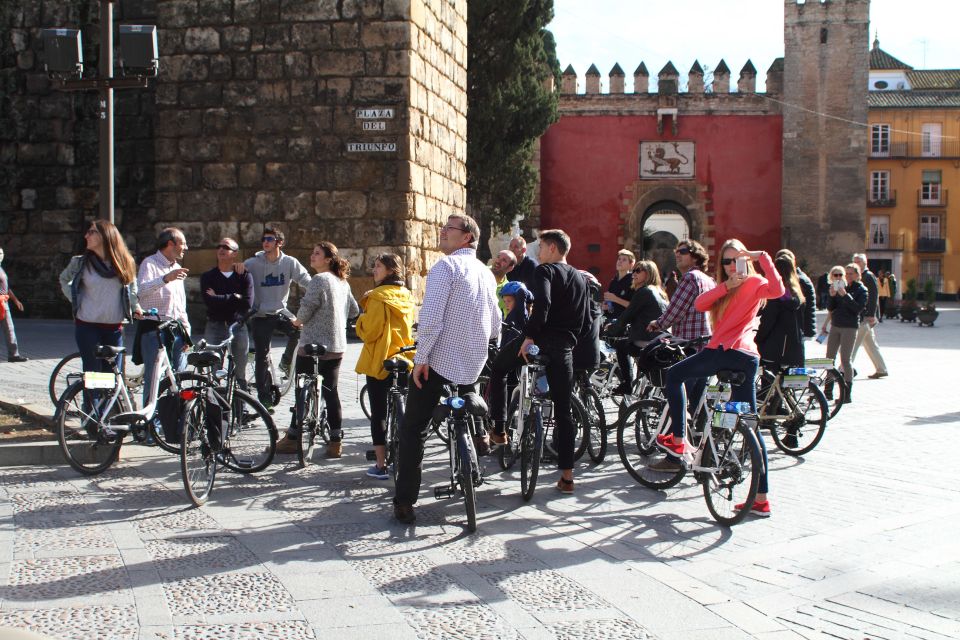
This is the kind of tour you book when you want the “best-of Seville” feeling without giving up your whole day. The timing is tight—2.5 hours—so you’re not just wandering plazas and guessing where to go next. You get a pre-set route that pulls you toward the city’s most important historic and monumental areas, in a logical flow that makes sense on a bike.
The best part is how the tour connects sites into a story. You start in an old-style Sevillian setting, then you work your way through landmark squares, the Cathedral area, an industrial-era heavyweight (the tobacco factory), and then the more open, iconic spaces around Plaza de España and the river sights near Torre del Oro. You end with the Mushrooms of Plaza de la Encarnación, where the city’s historic look meets something unmistakably modern.
This format is also good value because you’re not paying only for “sightseeing.” You’re paying for guide interpretation plus bike rental, water, a map, and—if you’re traveling with kids—helmets.
You can also read our reviews of more tours and experiences in Seville.

Where it starts: Centerbici and getting your bike ready
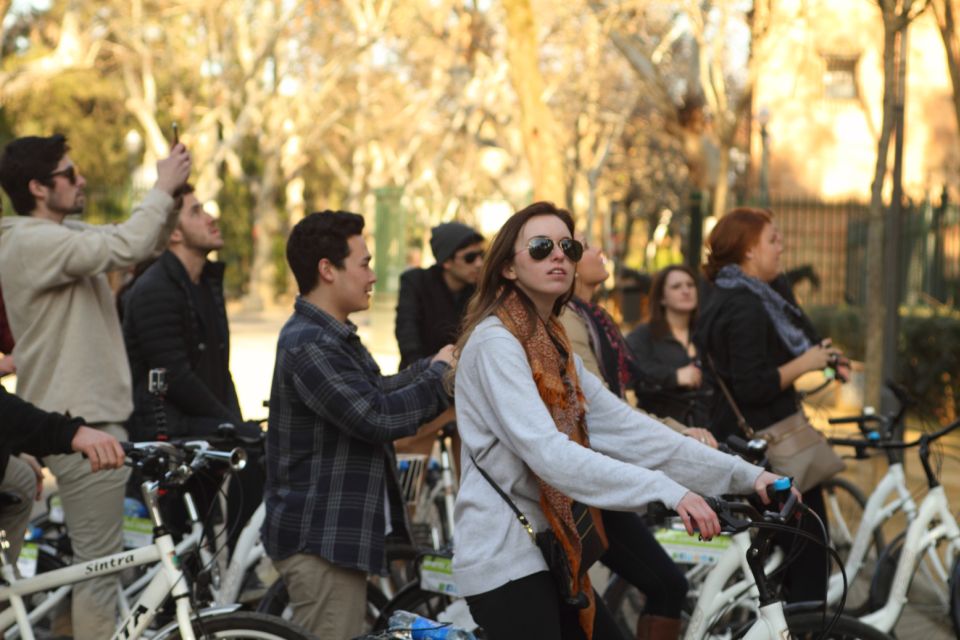
You meet at Centerbici, C/ Espronceda, 5 (41004 Sevilla). That matters because you’ll likely spend a few minutes right away sorting your bike, helmet (for children), and anything else you need before you roll out.
Since the tour relies on pedaling to make the timing work, do yourself a favor: take a minute at the start to check the bike’s basics—seat height, brakes, and whether the bike feels stable. Some recent experiences point to bike condition being hit-or-miss, so you don’t want to discover any issues once the route is underway.
If you’re worried about feeling rushed, remember this is a guided experience, not a DIY rental. The guide is there to keep the group moving and to explain what you’re seeing, so your job is simple: show up ready to pedal, and speak up if anything feels off with your ride.
The warm-up stop: a nineteenth-century house with a Sevillian patio
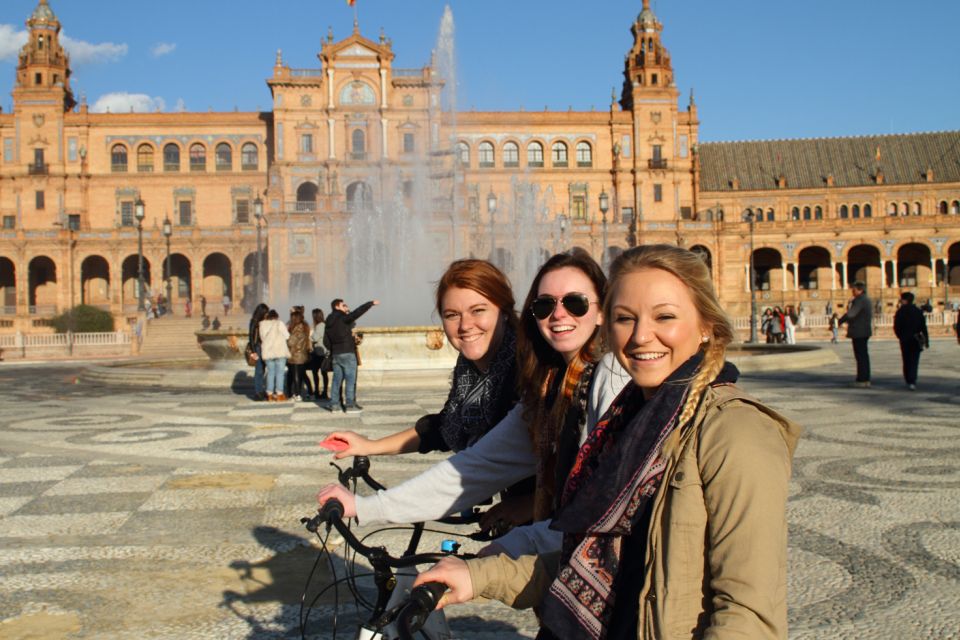
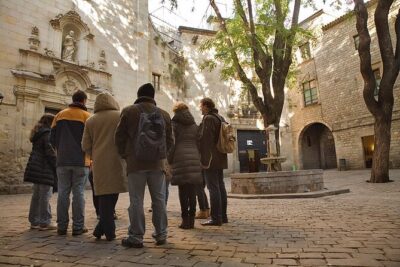
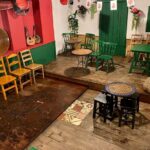
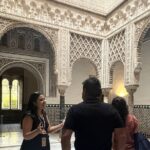
Before you hit Seville’s biggest squares, the tour begins from a nineteenth-century house you can view as operating from a typical Sevillian patio. This is a smart opening. Seville isn’t only cathedrals and tiled facades; it’s also an everyday way of building and living—courtyards, light, shade, and that indoor-outdoor rhythm.
Even if you’re not a “history museum” person, this start helps you read the city. Patios are a key to understanding why Seville feels the way it does—cool pockets of calm, the social pull of shared outdoor space, and a design that keeps daily life going even when the sun gets intense.
It’s the kind of introduction that pays off later. When you see the grand plazas and the monumental buildings, you’ll have a better sense of what came before the showpieces.
Plaza del Salvador, Plaza de San Francisco, and Plaza Nueva near City Hall
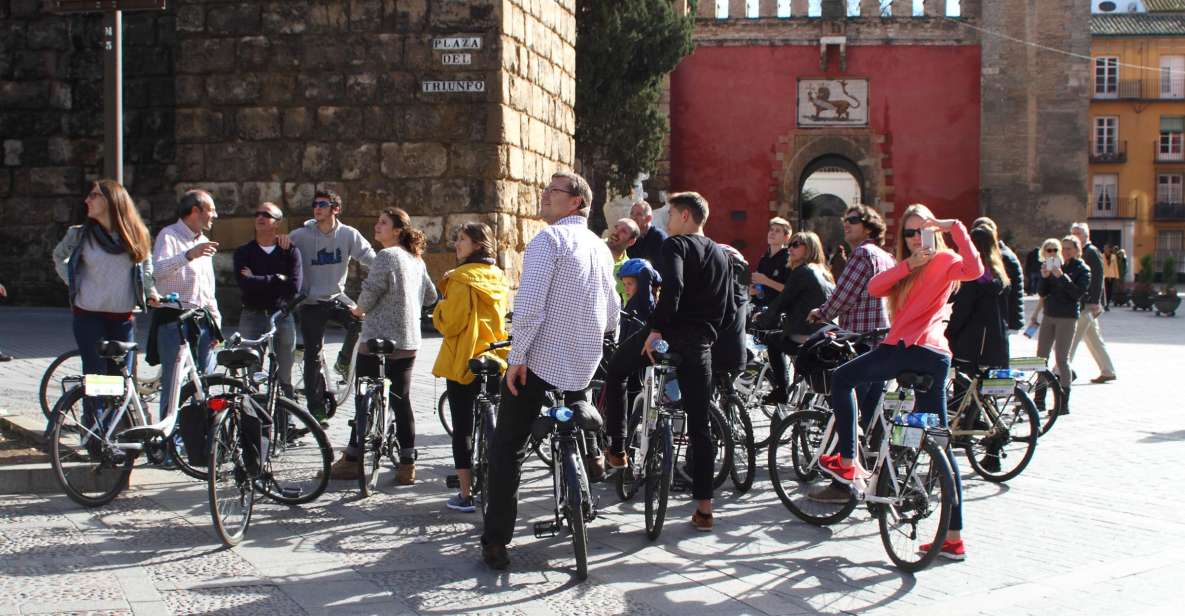
Once you’re rolling, the route moves into the core historic monumental zones—Plaza del Salvador, Plaza de San Francisco, and Plaza Nueva, near the City Hall. These are classic Seville squares for a reason: they’re where the city’s energy gathers, and they’re also where you get a concentrated dose of “this is the center of things” geography.
For me, what makes a guided pass through these plazas valuable is the context. You’re not just walking around open space; you’re learning what each place is, where it fits into the city’s growth, and what to notice beyond the obvious.
These squares also work well on a bike tour because the stops are clear and close enough that you can actually enjoy the explanation without the constant transit time eating the experience. If you’re the type who wants to see a lot but still learn something real, this is the sweet spot.
Avenida de la Constitución, the Cathedral area, and the Giralda
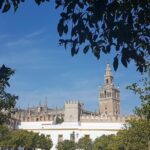
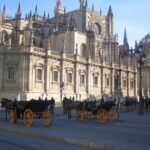
Next comes Avenida de la Constitución, leading you right toward the Cathedral area and the Giralda. This part matters because it’s the visual spine of Seville. The Giralda isn’t just a landmark; it’s a vertical focal point that changes how you navigate and how you understand the city’s skyline.
On a short tour, getting here with a guide is a win. You’ll get direction on what to look for and how the area’s history connects to Seville’s identity. And because the tour includes a skip the ticket line element, you’re less likely to lose your limited time to slow-moving queues.
Practical tip: bring a quick ID because the tour notes you should remember it. I’d rather you have that ready at the start than deal with last-minute stress.

The old Tobacco Factory: where industrial-era Seville gets personal
Then the route turns toward the old tobacco factory. This is one of the most interesting types of stops on a sightseeing loop: it brings you away from pure monument sightseeing and into the city’s working story.
A good guide will make the factory feel less like a single building and more like a chapter of Seville—how the city produced, organized work, and grew around economic forces. The tour specifically frames this stop with origins, trivia, and history, and that’s where a short guided ride can beat self-guided wandering. You’ll know what questions to ask when you look at the exterior and how to interpret the setting.
If you’re only visiting a few places in Seville, prioritize this part. It’s the kind of stop that turns the tour from a checklist into an actual understanding of the city.
Prado de San Sebastián to Plaza de España and Maria Luisa Park
From the tobacco factory zone, the route swings to Prado de San Sebastián, then continues toward Plaza de España and Maria Luisa Park. This is a big visual shift: from historic density to wide-open, iconic Seville scenes where you can feel the city’s postcard style without losing the storyline.
Plaza de España is the type of place that rewards a guided eye. You’ll likely get orientation on what you’re seeing and how the space functions as part of Seville’s identity. Maria Luisa Park adds the softer, greener breathing room so you don’t feel like you’re only looking at stone and towers.
On a bike tour, this segment is also useful because it helps you cover distance efficiently while still stopping enough to actually enjoy the atmosphere. You’re not sprinting through everything; you’re getting pauses where the guide can connect what you see to the city’s broader picture.
The Dock area, Real Maestranza, and Torre del Oro by the water
After Plaza de España and the park, the tour moves to the New York dock, then continues toward Real Maestranza and Torre del Oro. The names alone hint at the variety here—Seville by way of its waterfront connections, and the mix of heritage and spectacle tied to the area.
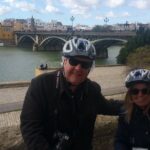
Torre del Oro is a highlight for many visitors because it’s so visually distinctive and anchored to the river setting. When your guide explains origins and trivia here, it’s not just “what it looks like,” but also “what it was for” and why the location mattered. Real Maestranza brings in another angle of Seville’s cultural life, which helps the overall tour feel less one-note.
This portion is a good time to slow your pace mentally. If you’ve been listening for the last hour, take the chance to look around for the river feel and the way the city turns outward in this area. The bike helps you get there fast; the guide helps you understand why the place matters.
Finishing at Plaza de la Encarnación’s Mushrooms: old vs. new Seville
You end at the Mushrooms of the Plaza de la Encarnación. That finish is clever because it creates a contrast on purpose: you’ve been looking at historic monuments and older urban rhythms, and then you step into a more avant-garde silhouette.
This is where the tour’s “Seville past and present” idea clicks. Even if you came for the classics like the Cathedral/Giralda and Plaza de España, ending at the Mushrooms gives you a memory that’s unmistakably modern. It helps you see Seville as a living city, not a theme park of old stones.
If you’re the kind of traveler who likes variety in a short time window, this ending makes the route feel complete—like you didn’t just collect photos, you got a contrast.
Price and value: is $35 for a Seville bike tour a good deal?
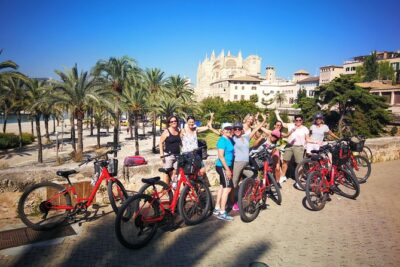
At $35 per person for about 2.5 hours, the pricing feels fair because you’re not only paying for a guide. You’re also getting bike rental, a bilingual guide, a water bottle, a map, and helmet rental for children. That’s real savings versus piecing it together on your own—especially on a time-limited trip.
You’re also getting a skip the ticket line benefit, which matters in Seville where queues can steal your energy. If you’re on a tight schedule, skipping that friction is part of the value.
Is it worth it for every traveler? If you hate bikes, or if you expect everything to be perfectly smooth (every bike brand-new), you might feel irritated. But for most people who want a guided, high-impact overview in one afternoon window, it’s a reasonable way to buy time and clarity.
Guides and bike condition: how to get the best experience
The tour’s quality often comes down to two things: the guide’s storytelling and the bike you’re given. The good news is that guides like Sébastien and Alexandro have been praised for explaining clearly and adapting to what people want to see. That’s exactly what you want on a short tour—someone who can read your interests and not drag you through a script.
Still, the bike condition has been mentioned as a concern in a few experiences: bikes may be old, and in rare cases, an arrangement issue can happen (like not having enough intact bikes at the station). You also want to be ready for the possibility that smaller bookings can be combined and information delivered in a different language than what you booked for.
So here’s how you protect your experience:
- Do a quick safety check on your bike at the start
- If language matters a lot to you, ask what language the group will use before you roll
- If you’re traveling with kids, double-check helmet fit early
With those basics handled, the tour can feel smooth and genuinely fun—especially because the guide work does a lot of the heavy lifting.
Who this Seville bike tour fits best (and who it doesn’t)
I’d steer you toward this tour if you’re:
- On a short Seville trip and want the big monuments plus the stories
- Comfortable riding a bike through city streets and plazas
- Interested in the contrast between historic Seville and the modern feel of the Plaza de la Encarnación Mushrooms
- Traveling with kids, because helmet rental for children is included
I would not choose it if you need an accessibility-friendly plan for mobility impairments, since it’s specifically listed as not suitable for that.
If you’re traveling solo or as a couple and want an efficient afternoon, it’s also a good match because it’s built as a guided loop rather than a slow amble.
Should you book this Seville sightseeing tour?
Yes—if you want a fast, story-led route that hits the Cathedral/Giralda area, Plaza de España, Torre del Oro, and ends with the Mushrooms of Plaza de la Encarnación. The $35 price makes sense for what’s included, and the best part is that the guide’s explanations help you see the city as a connected whole rather than a pile of monuments.
Before you book, take seriously the two practical realities: bikes can vary, and small-group combinations can change the language you hear. If that won’t bother you, this is a smart way to get orientation and a strong set of memories in just 2.5 hours.
If you prefer to stroll slowly with your own pace, you might find a bike tour too structured. But for most visitors who want Seville to feel understandable fast, this is an efficient, high-value choice.
FAQ
Where is the meeting point for the Seville 3-hour sightseeing tour?
You meet at Centerbici store, C/ Espronceda, 5 – 41004 – Sevilla.
How long is the tour?
The duration is 2.5 hours.
What sights does the tour include?
You’ll see major stops including Plaza del Salvador, Plaza de San Francisco, Plaza Nueva, the area at the Cathedral and the Giralda, the old tobacco factory, Prado de San Sebastián, Plaza de España and Maria Luisa Park, New York dock, Real Maestranza, Torre del Oro, and the Mushrooms of the Plaza de la Encarnación.
What’s included in the price?
Included items are a 3-hour tour, bike rental, a bilingual live guide, a water bottle and map, and helmet rental for children.
Are tickets required, and do you skip lines?
The tour includes skipping the ticket line.
Which languages are available for the live guide?
The guide is available in Spanish, English, French, Italian, and Dutch.
Is the tour suitable for people with mobility impairments?
No, it is listed as not suitable for people with mobility impairments.
What should I bring with me?
Please remember to bring your ID.
If you tell me your travel dates and whether you’re more into architecture, local history, or photo stops, I can suggest the best side of Seville to prioritize before and after this 2.5-hour ride.