REVIEW · SEVILLE
Seville Jewish Quarter Small-Group Walking Tour: History & Gems
Book on Viator →Operated by Seville Unique Experiences · Bookable on Viator
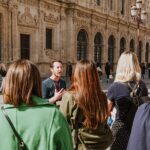
That street corner you’ve seen in photos has a second life. This small-group walk (max 10) guides you through the Jewish Quarter area with tight storytelling and stops that most people speed past. You’ll spend about 1 hour 30 minutes learning how medieval Seville worked, then you’ll end at a landmark that still anchors the memory.
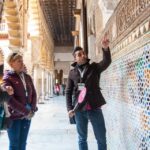
I like two things right away. First, the small group keeps the pace relaxed and the questions coming fast. Second, the guides use stories to connect locations to what life may have felt like before the community was pushed out.
One thing to consider: physical leftovers are limited. You’ll hear plenty of big, often heartbreaking events, but you’ll also need a bit of imagination because there isn’t much standing architecture to point at.
In This Review
- Key Highlights You’ll Actually Feel on the Walk
- Why This Tiny-Group Jewish Quarter Tour Feels Different
- Where the Tour Starts: Alcázar Area to Begin at the Right Angle
- Plaza Patio de Banderas: Using the Alcázar Area to Read Medieval Seville
- Plaza de Doña Elvira: A Tiny Square With Big Community Memory
- Plaza de Santa Cruz: Where Synagogue History Lives Mostly in Story
- Jardines de Murillo: Reading the Neighborhood Through Its Walkable Edges
- Calle Cano y Cueto: The Only Physical Remains, Inside an Underground Site
- Iglesia de Santa Maria la Blanca: Ending at a Place That Still Holds Layers
- The Guides: Names You Might Hear and What They Seem to Do Best
- Price and Value: Paying for Context, Not Just Walking
- Timing, Pace, and What to Expect From the Walk
- Who This Tour Suits Best (and Who Might Want Something Else)
- Booking Tips That Will Save You Time
- Should You Book This Seville Jewish Quarter Tour?
- FAQ
- How long is the Seville Jewish Quarter small-group walking tour?
- What’s the maximum group size?
- Is the tour offered in English?
- Where does the tour start and end?
- Are there paid admission tickets for the stops?
- Is free cancellation available?
Key Highlights You’ll Actually Feel on the Walk
- Max 10 people: A genuinely personal walk where questions don’t get lost.
- Story-led stops: Each plaza links to Jewish life, synagogues, or the neighborhood’s shifting communities.
- Ahead-of-the-curve sights: You’ll pass through quieter corners of Santa Cruz, not just the busiest photo spots.
- Rare physical remnants: One stop includes the only physical remains of the medieval Jewish quarter, located at an archaeological site inside an underground car park.
- Ends at Santa Maria la Blanca: You finish at a church tied to the area’s layered religious past.
- Free admission at each stop: The itinerary’s listed stops don’t require paid entry tickets.
Why This Tiny-Group Jewish Quarter Tour Feels Different
Seville’s Santa Cruz area looks like a postcard. But after a while, postcards blend together: narrow lanes, white walls, the same “view from the balcony” shots. This tour changes the angle. You don’t just walk through the neighborhood—you learn how it all made sense for the people who lived there.
The small group matters more than you’d think. With up to 10 people, you get breathing room at each plaza. You’re not craning your neck to hear over a crowd, and the guide can actually follow up when you ask something specific. I also like the timing: about 90 minutes is long enough to feel like you learned something real, but short enough to keep your energy for the rest of the day.
Second, it’s built around context. You start near the Alcázar area and work your way through the Jewish Quarter footprint. Along the way, your guide points out what’s still visible, what’s vanished, and why the missing pieces still matter.
One more honest note: the story isn’t all sunshine. You’ll learn about the expulsion and loss of Jewish life in the city. That sadness is part of the historical record, and you’ll feel it in the way the stops are framed.
You can also read our reviews of more walking tours in Seville


Where the Tour Starts: Alcázar Area to Begin at the Right Angle
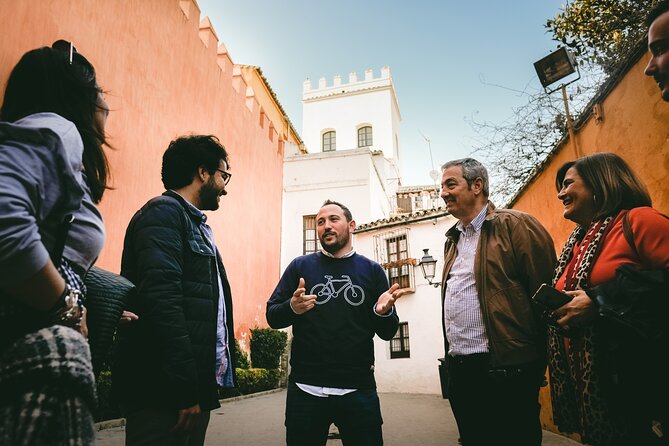
The meeting point is at Monumento a la Inmaculada Concepción on C. Joaquín Romero Murube, in Seville’s Casco Antiguo. The end is at Iglesia de Santa María la Blanca (C. Sta. María la Blanca, 5), also in the old center.
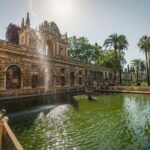
Starting near the Alcázar Royal Palace is a smart move. This area is tied to Moorish-era Seville, and the tour uses that as your springboard. Before you even enter the Jewish Quarter vibe, you get a medieval baseline: how Seville’s rulers, religions, and power shifts shaped who could live where and under what conditions.
If this is your first day in Seville, you’ll appreciate the orientation. The walk gives you a “mental map,” so later on you can wander and recognize what you’re seeing instead of just admiring it.
And yes, you’ll be on your feet. Expect a walking pace that allows discussion at each stop, not a sprint through alleyways. If you want a structured intro without a museum-style lecture, this is a nice fit.
Plaza Patio de Banderas: Using the Alcázar Area to Read Medieval Seville
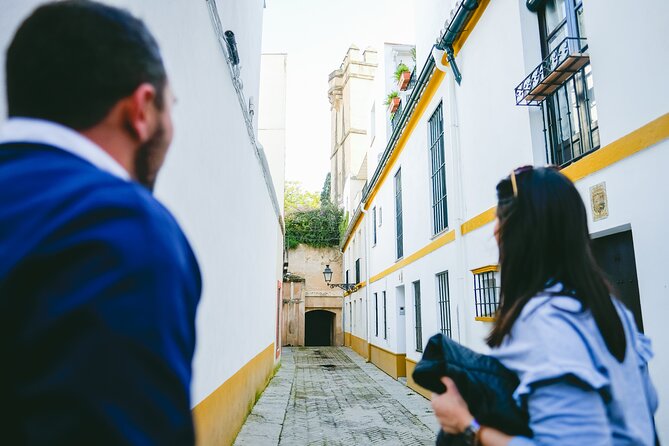
Stop one is Plaza Patio de Banderas, with the guide orienting you around the Alcázar surroundings. Even if you’re not going into the palace itself, you’re standing next to a big piece of Seville’s timeline.
Here’s what makes this stop useful: it’s not a random kickoff. You’re getting the medieval “before” so the “during” makes sense once you shift toward the Jewish Quarter. The tour connects Moorish-era history to the later Christian period, helping you understand how Seville’s urban life evolved rather than just listing dates.
You’ll probably notice how your brain works differently after this. Later, when you hear about communities living in specific zones, you can picture how the city’s power centers influenced daily life—streets, rules, and the social boundaries people navigated.
Time-wise, this stop is about 15 minutes. It’s long enough for real context, short enough that you stay energized for the next plaza.
Plaza de Doña Elvira: A Tiny Square With Big Community Memory

Stop two is Plaza de Doña Elvira, described as a small square where the past of the communities in the area comes into focus.
This is the kind of place where a guide really earns their pay. A plaza like this can look “generic” if you’re just passing through. But with the right framing, it becomes a stage: who lived nearby, how the neighborhood shifted over time, and what that meant for Jewish residents.
The tour’s strength here is interpretation. It’s not just saying, This happened here. It’s helping you understand why it would matter to the people who were there—socially, legally, and day-to-day.
This stop also reinforces the tour’s overall approach: you’re heading off the usual tourist trail and leaning into places that feel quieter and more local.
Plaza de Santa Cruz: Where Synagogue History Lives Mostly in Story
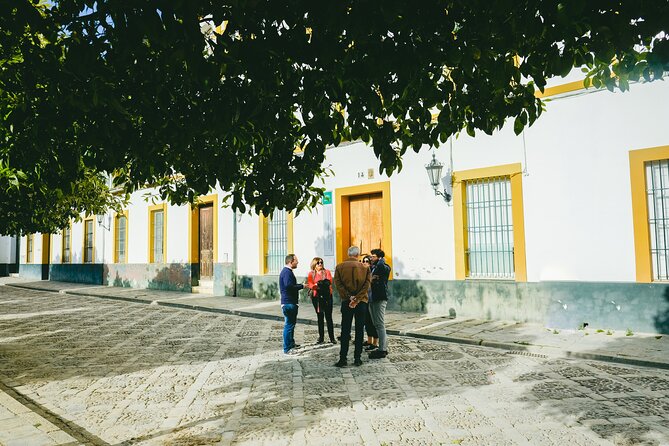
Stop three is Plaza de Santa Cruz. This is where the tour shifts more directly toward the Jewish religious landscape, including the past synagogues associated with the city.
If you’ve visited Seville before, you might remember Santa Cruz as a beautiful old neighborhood full of lanes and courtyards. The tour adds the missing layer: what those streets may have meant to Jewish life during the city’s medieval heyday.
One reality you’ll learn quickly: you won’t see a lot of intact synagogue architecture. That doesn’t make the information less important. In fact, it’s often the point. The tour uses storytelling to preserve what physical traces can’t.
Expect another 15-minute stop. Short, focused, and designed to keep the walk moving without rushing you.
You can also read our reviews of more historical tours in Seville





Jardines de Murillo: Reading the Neighborhood Through Its Walkable Edges
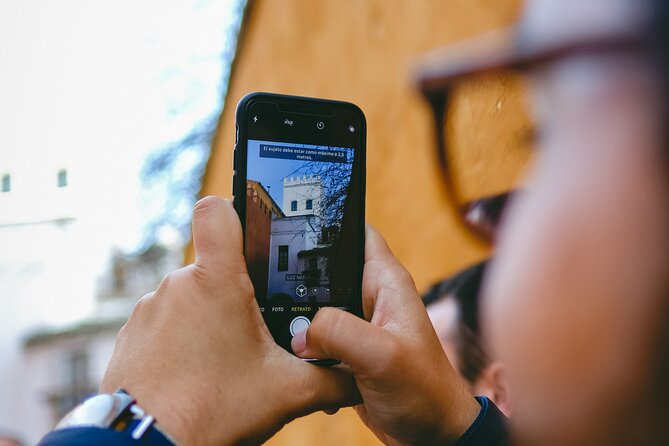
Stop four is Jardines de Murillo. The tour passes through these gardens while discussing the history of the neighborhood.
Gardens can turn into “just a nice break” on walking tours. Here, you get a different use: the guide uses the space to help you think about how the area functioned. Green pockets also change walking rhythm—sound drops, foot traffic shifts, and suddenly you’re not hearing the same street-level noise. That makes it easier to picture older routines.
You’ll also start to see why the tour is built around small checkpoints. Each one is placed to help you imagine daily patterns: routes, meeting points, and how religious communities fit into the broader urban setting.
This stop is again about 15 minutes, and it’s a good moment to reset before the more archaeology-focused piece of the tour.
Calle Cano y Cueto: The Only Physical Remains, Inside an Underground Site
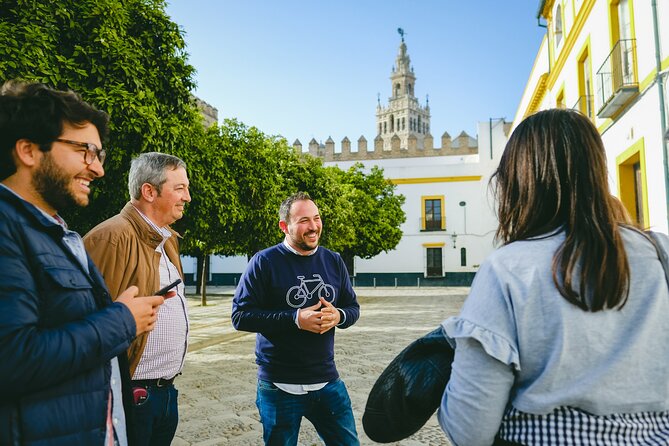
Stop five is Calle Cano y Cueto, and it’s one of the most compelling stops on paper—because it addresses the question you’ll be thinking in your head the whole time: if so much was erased, what’s left?
Here’s the key detail: this stop is at an archaeological site inside an underground car park, and it’s described as showing the only physical remains of the medieval Jewish quarter.
That’s a very specific kind of site. And it changes how you process the entire tour. Instead of only hearing about what happened, you’re confronted with the stubborn fact that history sometimes survives below street level, behind modern infrastructure, and in fragments you have to work to notice.
This is also where the tour’s “use your imagination” theme becomes practical. When the guide points out what you can actually see, you’ll realize how thin the line can be between daily life centuries ago and what’s visible today.
It lasts about 15 minutes, but it sticks with you because it feels like proof—quiet proof, not a dramatic monument.
Iglesia de Santa Maria la Blanca: Ending at a Place That Still Holds Layers
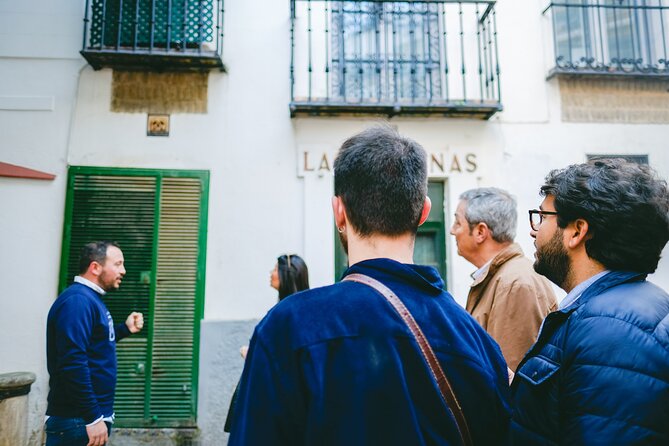
Stop six, and the finish line, is in front of Iglesia de Santa Maria la Blanca.
This is a smart ending because the church helps you close the loop. Earlier stops talk about synagogues and community memory. Ending at a religious landmark tied to the area’s layered past lets you “land” the story somewhere tangible.
Even if you’ve only learned the basics of Seville’s Jewish timeline, you’ll leave with a clearer mental map of how religion, power, and urban space interlocked. And because the tour ends here, it’s easy to continue your exploration afterward without having to retrace your steps.
Time is about 15 minutes here, and it gives you a natural stopping point—exactly the length you need to wrap up without turning it into a late-day slog.
The Guides: Names You Might Hear and What They Seem to Do Best
One of the strongest themes in the feedback is the guides’ ability to make the story feel personal and answer questions without turning you into a passive listener.
I saw several guide names come up repeatedly: Miguel, Marta, José, Guillermo, Valentín, Clara, Barbara, and Carmen.
What stands out from their styles in the feedback is how they handle the two hardest parts of this topic: nuance and emotion.
- Miguel is praised for a relaxed pace and the ability to answer lots of questions while keeping the walk flowing.
- Marta gets credit for engaging storytelling and deep understanding that makes the past feel connected to Seville’s present-day fabric.
- José is highlighted for exceptional knowledge and strong people skills, which is a big deal on a tour where history can get heavy.
- Valentín is noted for humor and even teaching Ladino expressions—small details that make learning feel human instead of textbook-only.
- Clara and Barbara are both described as excellent at answering questions and explaining in a way that makes the area’s meaning click.
- Carmen is mentioned for lots of information and making it enjoyable, while also benefiting from the small group size.
If you get one of these guides, you’re likely to experience a tour that balances facts with storytelling—and that’s what helps when physical traces are scarce.
Price and Value: Paying for Context, Not Just Walking
The price is $32.65 per person for about 1 hour 30 minutes. That’s not “cheap,” but it’s also not museum-priced. For me, the value comes from what you’re buying: guided interpretation.
You could wander Santa Cruz on your own and see beautiful streets. But without a guide, most people don’t connect the plazas and fragments to the Jewish life and later expulsions that shaped the neighborhood.
You’re also getting a maximum of 10 people, which keeps the group manageable and makes the guide’s attention feel more direct. In other words, you’re paying partly for access and partly for clarity—turning scattered information into a storyline that fits together.
Another value point: the tour’s stops are listed with admission ticket free for each checkpoint. So you’re not stacking paid entries on top of the tour fee.
If you’re the type who likes to understand why a place looks the way it does, this price makes sense. If you only want photos and casual strolling, you might find it heavy.
Timing, Pace, and What to Expect From the Walk
This tour runs about 1.5 hours, with each stop around 15 minutes. That structure matters because you’re never stuck in one spot too long, and you don’t feel rushed through the important bits.
Also, Seville can be hot. Even when you’re not told anything specific, plan like you might be walking in sun and stone. Wear comfortable shoes and bring water if you tend to get thirsty quickly.
A nice bonus from the tour format: it’s offered in English, and the guide can handle questions. The feedback repeatedly mentions the ability to answer questions easily, which is great if you like to go beyond the script.
If you’re planning your day, think of this as a high-impact “first pass” through the Jewish Quarter footprint. After this, you’ll be better at spotting what you’re looking at—especially because you’ll know what’s missing and why.
Who This Tour Suits Best (and Who Might Want Something Else)
This tour is a strong match if you:
- want history tied to specific streets and plazas
- like small-group walking tours with real discussion
- enjoy context more than just sightseeing
- are curious about Jewish life in medieval Spain—even when much of it is gone
It also fits well if you’re in Seville for a short time and want a structured orientation walk.
It might be less ideal if you:
- want a light, purely scenic walk
- dislike sad historical themes
- expect lots of surviving synagogue buildings to view directly
Because the physical remains are limited, you’ll get the most from this if you’re willing to imagine what’s missing and let the guide’s explanations do the heavy lifting.
Booking Tips That Will Save You Time
This one tends to sell ahead. It’s booked on average about 17 days in advance, so if Seville is busy during your dates, I’d reserve early rather than hoping for a last-minute slot.
You’ll also use a mobile ticket, which is convenient when you’re bouncing between sights. Confirmation is received at the time of booking, so you won’t be chasing emails later.
If you’re traveling with a service animal, note that service animals are allowed.
If you like, you can use free cancellation up to 24 hours in advance, which gives you flexibility if plans change.
Should You Book This Seville Jewish Quarter Tour?
I’d book it if you want more than a pretty stroll through Santa Cruz. This tour is built to teach you how Seville’s Jewish story fits into the city’s wider medieval shifts—using a small group, specific plaza stops, and the rare physical remains at Calle Cano y Cueto.
I also think it’s worth it because of what the guides seem to do best: keep the pace comfortable, explain clearly, and answer questions without making it feel like a lecture. Names like Miguel, Marta, and Valentín show up for a reason: they manage to turn limited visible ruins into something you can actually understand.
If you only want upbeat history or you’re expecting major synagogue ruins to tour, you may leave slightly frustrated. But if you’re okay with the reality of what survives—and you want the story behind those walls—this is a smart, value-for-money way to see Seville with better eyes.
FAQ
How long is the Seville Jewish Quarter small-group walking tour?
The tour is about 1 hour 30 minutes.
What’s the maximum group size?
The group size is limited to a maximum of 10 travelers.
Is the tour offered in English?
Yes, it’s offered in English.
Where does the tour start and end?
It starts at Monumento a la Inmaculada Concepción on C. Joaquín Romero Murube and ends in front of Iglesia de Santa María la Blanca on C. Sta. María la Blanca, 5.
Are there paid admission tickets for the stops?
The itinerary lists admission ticket free for the stops included on the walk.
Is free cancellation available?
Yes. You can cancel up to 24 hours in advance for a full refund.