REVIEW · MADRID
Tour en tuk-tuk electrico por MADRID MODERNO
Book on Viator →Operated by TUK TUK MADRID · Bookable on Viator
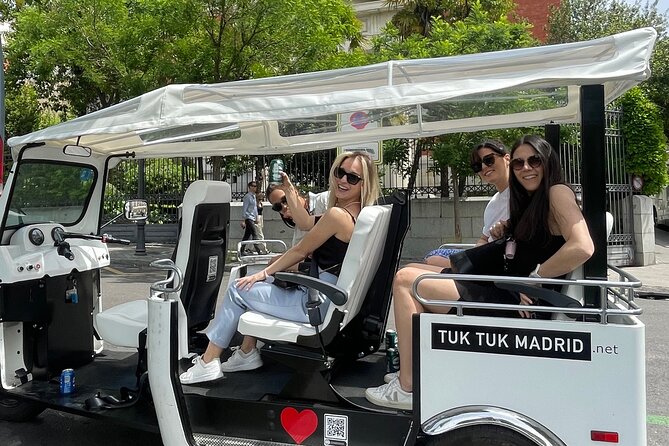
A good city overview should feel easy, not rushed. This electric tuk-tuk tour gives you a smart sweep of Madrid’s biggest monuments in about 90 minutes, with an English guide and plenty of photo stops. I like that it’s built for quick orientation, not a museum marathon. The big win is moving through neighborhoods and roundabouts without turning your legs into sandpaper.
Two things I genuinely like: first, the guide uses short, clear explanations at each stop, so you get the “what am I looking at?” without needing to study beforehand. Second, the private group format (up to 4) makes it feel more personal than the usual bus shove-and-go.
One drawback to keep in mind: the experience depends on day-of pickup and timing. If anything goes sideways at the meeting point, you’ll want to stay on top of communication and keep a little buffer.
In This Review
- Key points that make this tour worth considering
- Why an electric tuk-tuk tour fits Madrid
- Price and value for up to four
- Meeting point and timing: making the 9:00 start painless
- Royal Palace to Almudena Cathedral: Madrid’s power on display
- Royal Palace area: scale first, details second
- Almudena Cathedral: different styles, one dramatic building
- San Francisco el Grande and the city’s old-center geometry
- Puerta de Toledo and Neptune Fountain: circular Madrid at street level
- Toledo Gate: a triumphal arch with a modern date
- Neptune Fountain in Plaza de Cánovas del Castillo
- Atocha station and Reina Sofía: transit meets modern art
- Atocha Station: the busiest hub vibe
- Reina Sofía Museum: the old hospital that became a museum
- The Retiro zone: Jerónimos, the Casón, and the Salón de Reinos
- Los Jerónimos (San Jerónimo el Real)
- Casón del Buen Retiro: survival after the palace was gone
- Salón de Reinos: from royal paintings to the Army Museum
- Real Academia Española and the Prado: language and masterworks
- Real Academia Española: Spanish language at the institutional level
- Museo del Prado: yes, it deserves its reputation
- Puerta de Alcalá, Las Ventas, and Salamanca’s shopping streets
- Puerta de Alcalá: a classic royal gate
- Las Ventas bullring: big scale, big arena energy
- Barrio de Salamanca: high-end streets, tidy neighborhoods
- Plaza de Colón, the National Library of Spain, and Gran Vía
- Plaza de Colón: Columbus in neo-Gothic style
- National Library of Spain: 30 million items guarded
- Gran Vía: Madrid’s Broadway section
- Cibeles and the Bank of Spain: the big neoclassical set piece
- Cibeles Fountain: “Salón del Prado” energy
- Bank of Spain: architecture built to command the square
- How to get the most from short stops
- What your guide can add (and how the audio feels)
- Should you book this electric tuk-tuk Madrid Modern tour?
- FAQ
- How long is the Madrid Modern electric tuk-tuk tour?
- What group size is this tour for?
- What’s included in the price?
- Is the tour offered in English?
- Where does the tour start and end?
- What sights will we see during the ride?
- Are there any ticketed stops?
- How do I get my tickets?
- What should I do if I’m sensitive to noise on city streets?
Key points that make this tour worth considering
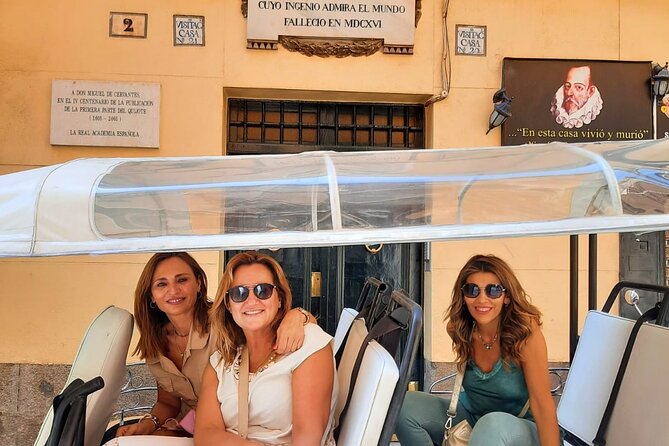
- Electric tuk-tuk convenience: you cover a lot of ground with less walking than a standard sightseeing loop
- 90-minute “highlights only” pace: ideal if you’re arriving to Madrid and want quick context first
- Big-photo energy: you can pause briefly at major sights and still hear the key story behind them
- Excellent guide value: multiple guides named in the experience feedback, including Juan, Jimena, Javier, José, and George
- Modern + classic mix: Royal Palace and Almudena Cathedral side-by-side with Reina Sofía and Atocha
- Audio can be affected by traffic: in heavier traffic, you might need to pay closer attention to the guide’s headset setup
Why an electric tuk-tuk tour fits Madrid
Madrid can be slow in traffic and long on walking. An electric tuk-tuk turns that into an advantage because you’re not fighting the city on foot, especially when streets get busy or you’re crossing between major districts.
Also, Madrid’s “wow” is often in details: a facade, a dome, a whole skyline view from a plaza. This tour is designed to give you those quick hits, then point you toward where you should slow down later.
You can also read our reviews of more tours and experiences in Madrid.


Price and value for up to four
At about $131.54 per group (up to 4), the math works best when you’re traveling with someone. Instead of paying per person like a typical bus tour, you split the group cost and get a private experience.
Is it a bargain compared to a free walking route? Sometimes, yes. But what you’re paying for is time and transport: you get a tight overview of places like the Royal Palace area, Almudena Cathedral, and the Reina Sofía zone without spending your whole day commuting by metro and walking between scattered stops.
Meeting point and timing: making the 9:00 start painless
The tour starts at 9:00 am at C. de Vergara, 1, Centro, 28013 Madrid, and it ends back there. I recommend getting there a bit early, not because it’s required, but because you’ll feel calmer if there’s any confusion with pickup timing.
Since it’s a private tour and your group is small, the schedule matters more than on a large group bus. The best move is to arrive ready to roll with your phone for the mobile ticket, then stay flexible if traffic affects the route.
Royal Palace to Almudena Cathedral: Madrid’s power on display
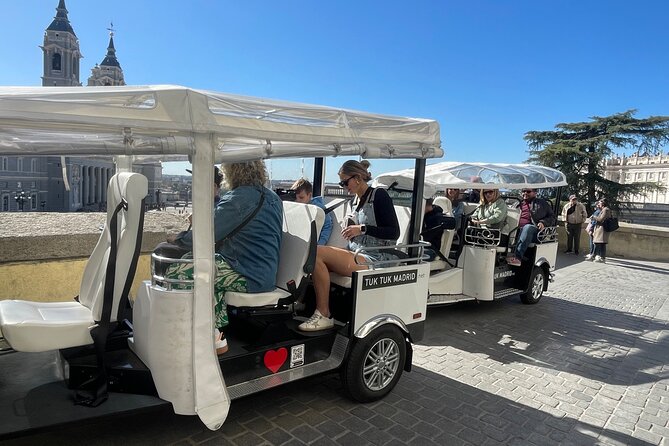
The first major stops put you right in the royal and religious center of the city.
Royal Palace area: scale first, details second
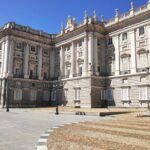
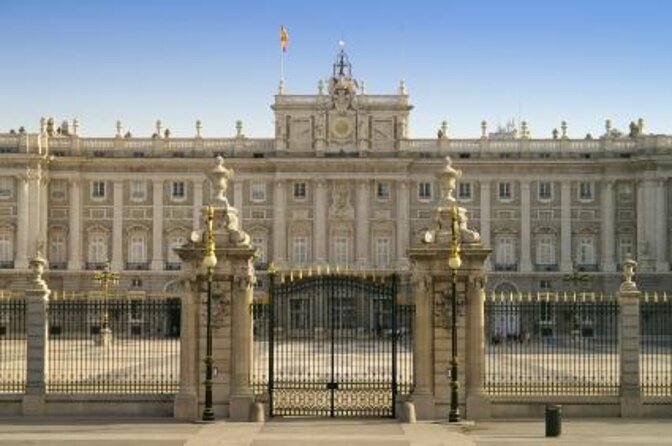
The Royal Palace of Madrid is the official residence of Spain’s king, with an enormous footprint and thousands of rooms. Even if you don’t go inside on this tour, you’ll feel the scale from outside—this is one of those structures that makes you understand why Madrid wanted a palace that could “hold court.”
What to do: take a few photos from the right angle, then listen for the guide’s quick context about why this palace became such a symbol of the monarchy.



Almudena Cathedral: different styles, one dramatic building
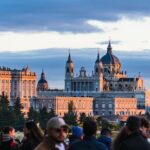
Next is the Almudena Cathedral, dedicated to the Virgin Mary under the invocation of Almudena. The fun part is that it’s not one “look”—it reflects different design eras: neoclassical outside, with neo-Gothic inside, and a distinct neo-Romanesque crypt.
What to do: don’t rush past it. Even from outside, the cathedral’s position in the historic center makes it feel like a cornerstone of Madrid’s identity.
San Francisco el Grande and the city’s old-center geometry
The Royal Basilica of San Francisco el Grande sits in Madrid’s historic center area, dominating the western face of Plaza de San Francisco. It’s also connected to a Franciscan convent dating back to the early 1200s, which gives the place a longer timeline than many of the city’s newer-looking streets.
Why it matters on a tuk-tuk: in a short 90-minute window, this kind of stop gives you a sense of how Madrid’s old neighborhoods are organized—plazas, intersecting streets, and big religious landmarks acting like anchors.
Puerta de Toledo and Neptune Fountain: circular Madrid at street level
Madrid loves its roundabouts. Two of the most photogenic ones show up here.
Toledo Gate: a triumphal arch with a modern date
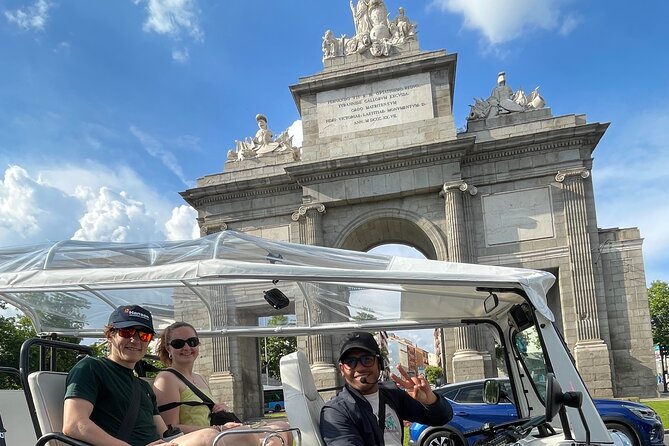
The Toledo Gate was originally one of Madrid’s access gates. The current structure dates from the first third of the 180th century and was designed by Antonio Aguado as a triumphal arch honoring King Ferdinand VII, marking independence after the French occupation.
What to do: if you’re a history person, this is a great stop to slow down for a minute. If you’re not, still look at it closely—the arch form is unmistakable once you know what it represents.
Neptune Fountain in Plaza de Cánovas del Castillo
The Neptune Fountain is a neoclassical centerpiece in the middle of its plaza. It was proposed in 1777, construction began in 1782, and it was finished in 1786, then later moved to this spot in 1898.
What to do: compare it in your mind to other fountains in Madrid’s central axis. Even if you don’t catch every statue from your seat, it helps you “see” the city’s aesthetic planning.
Atocha station and Reina Sofía: transit meets modern art
This tour doesn’t stick to one era. It swings from monumental architecture to art and major rail infrastructure.
Atocha Station: the busiest hub vibe
Atocha station is a key railway junction and is described as having the highest passenger traffic in Spain. It started as a halt in 1851, then expanded and became what you’d recognize today.
If you’ve been in Madrid before, you already know Atocha is where people bustle toward destinations. Even on a quick stop, it helps you understand the city’s geography—Madrid isn’t only historic buildings; it’s also a working crossroads.
Reina Sofía Museum: the old hospital that became a museum
The Museo Reina Sofía (MNCARS) is one of Madrid’s core contemporary art stops. It’s housed in the former General Hospital building (the Sabatini building) near Atocha, and the museum later expanded with the Nouvel building.
Here’s the practical takeaway: this stop gives you an immediate sense of how Madrid repurposes older structures. And for famous art connections, you’ll hear about Picasso’s Guernica—it was moved to Reina Sofía in 1992.
The Retiro zone: Jerónimos, the Casón, and the Salón de Reinos
If you want “Madrid at a slower speed,” this part of the tour is where your brain starts to soften.
Los Jerónimos (San Jerónimo el Real)
The old monastery of San Jerónimo el Real, known as Los Jerónimos, is near the Retiro area and is one of Madrid’s most important monasteries. On this tour it’s a brief stop (and it’s marked free), so don’t expect a long visit—expect a quick orientation to a major landmark.
What to do: use this time to decide whether you want to come back later for more time.
Casón del Buen Retiro: survival after the palace was gone
The Casón del Buen Retiro is one of the only two surviving buildings from the old Buen Retiro Palace. Built in 1637, it originally served as a ballroom space for court life. Later, it became part of the Prado Museum and housed collections for decades.
This stop is especially interesting if you like the story of how cultural buildings shift roles over time. You’ll also hear about Guernica being moved to Reina Sofía, which connects two of Madrid’s best-known art institutions in one sweep.
Salón de Reinos: from royal paintings to the Army Museum
The Salón de Reinos was the representative axis of the former Buen Retiro Palace, built between 1630 and 1635. It’s tied to the coats of arms of the 24 kingdoms under Philip IV, and it later carried a totally different identity when it housed the Army Museum for a long stretch of time.
On a tight tuk-tuk schedule, the value is perspective: you’re seeing how power, empire, and national identity all used the same kinds of impressive rooms.
Real Academia Española and the Prado: language and masterworks
This section pairs culture in language form and culture in painting form.
Real Academia Española: Spanish language at the institutional level
The Royal Spanish Academy (RAE) is a publicly funded cultural institution devoted to the Spanish language. Founded in 1713 with King Felipe V’s approval the next year, it’s one of the anchor institutions in Spain’s language ecosystem.
It’s a short stop and admission isn’t included here, so think of it as a quick “where does Spanish language authority live?” moment rather than a full visit.
Museo del Prado: yes, it deserves its reputation
The Museo Nacional del Prado is one of the world’s major art museums, and it’s especially strong in Spanish and European masters. You’ll hear how packed it is with artists like Velázquez, El Greco, and Goya, plus works by Titian, Rubens, and Bosco.
This stop is marked free for admission and short in duration. That means the goal isn’t to see everything. The goal is to leave Madrid with a short list of artists you should chase later when you buy a longer museum ticket.
Puerta de Alcalá, Las Ventas, and Salamanca’s shopping streets
Now the tour turns outward toward some of Madrid’s most recognizable “city life” landmarks.
Puerta de Alcalá: a classic royal gate
The Puerta de Alcalá is one of the old royal gates, located in the Plaza de la Independencia roundabout area. In a city full of historic monuments, it’s a great way to reset your brain and check your bearings.
Las Ventas bullring: big scale, big arena energy
The Las Ventas bullring is the largest bullring in Spain. It seats 23,798 people, and it’s listed as the third largest in the world after those in Mexico and Valencia. Even if bullfighting isn’t your thing, it’s still an impressive example of how Madrid builds major public venues.
Practical note: in a short stop, focus on the scale and setting. You’ll already have seen palaces and cathedrals—this adds “public spectacle” to your mental map.
Barrio de Salamanca: high-end streets, tidy neighborhoods
The tour then heads into Barrio de Salamanca, famous for luxury shopping and a very high standard of living. You’ll be in the area around Serrano, Claudio Coello, and Ortega y Gasset streets.
On a 20-minute stop, the point isn’t to buy anything. It’s to understand how Madrid’s modern wealth and city planning show up at street level.
Plaza de Colón, the National Library of Spain, and Gran Vía
This is the “Madrid in motion” stretch.
Plaza de Colón: Columbus in neo-Gothic style
The Plaza de Colón is where several major streets converge, and it’s named after Christopher Columbus. There’s a neo-Gothic monument, erected between 1881 and 1885.
If you’re trying to make sense of central Madrid quickly, this plaza is a useful landmark. It’s a good spot to pause and then mentally connect the street network.
National Library of Spain: 30 million items guarded
The National Library of Spain (BNE) is an autonomous body that preserves Spain’s bibliographic and documentary heritage, holding around 30 million publications produced since the early 18th century.
A short stop here works because it broadens your mental picture of Madrid beyond tourism. It reminds you that Madrid is also a place where knowledge gets preserved at massive scale.
Gran Vía: Madrid’s Broadway section
Gran Vía is one of Madrid’s main streets, beginning around Calle de Alcalá and ending at Plaza de España. It’s famous for cinemas and has sections nicknamed Madrid’s Broadway, especially between Plaza de Callao and Plaza de España.
If you walk Gran Vía on your own later, you’ll have more context. You’ll know this isn’t random commercial sprawl; it’s a planned landmark street from the early 1900s.
Cibeles and the Bank of Spain: the big neoclassical set piece
The tour ends with two of Madrid’s most recognizable institutions wrapped around one of its best-known plazas.
Cibeles Fountain: “Salón del Prado” energy
The Cibeles fountain is a monumental neoclassical fountain in the center of Plaza de Cibeles. It was part of an urban remodeling project initiated under King Carlos III, with a set of sculpted fountains and a wider plan that connected gardens and major institutions.
The practical reason this stop sticks: it’s one of Madrid’s easiest places to meet, point at, and remember. If your first day feels like information overload, Cibeles is the visual anchor that helps your brain sort it all.
Bank of Spain: architecture built to command the square
The Bank of Spain headquarters overlooks Plaza de Cibeles, built between 1884 and 1891. It’s positioned at the confluence of Calle Alcalá and Paseo del Prado, which makes it a natural “look up and take in the mass” moment even if you’re seated in your tuk-tuk.
How to get the most from short stops
This is not a tour where you linger for hours in each building. You’re using brief stops for orientation, exterior views, and quick context—exactly the kind of pace that works when you’re time-limited.
If you want a simple strategy, do this: pick one stop to explore longer later (like Prado or Reina Sofía), and let the rest be about learning where things are. You’ll come back smarter instead of trying to do everything at once.
Also: bottled water is included, which helps when the morning is already warm or you want to stay focused without hunting for a shop.
What your guide can add (and how the audio feels)
The experience is guided, and the tone matters. In the feedback I’m drawing from, guides named Juan, Jimena, Javier, José, and George were praised for English that works and for the balance between stories and keeping the tour moving.
One thing to watch: traffic can make it harder to hear. If the tour uses individual listening devices, pay attention early and adjust as needed so you’re not missing the guide’s explanations during the busiest road sections.
Should you book this electric tuk-tuk Madrid Modern tour?
I’d book it if you’re:
- arriving in Madrid and want a fast way to learn the city layout
- traveling in a small group (up to 4) and want value that doesn’t spike per person
- more excited by “see the sights and decide what’s next” than by spending the whole day inside museums
I might skip it if:
- you need long time inside major museums on day one
- your schedule is extremely tight and you can’t absorb a little delay at the meeting point if something goes wrong
If you do book it, come with one plan: choose one museum you truly care about (Prado or Reina Sofía are the obvious choices from this route) and use the tuk-tuk loop to figure out where you’ll spend your deeper time.
FAQ
How long is the Madrid Modern electric tuk-tuk tour?
It’s about 1 hour 30 minutes (approximately).
What group size is this tour for?
It’s priced per group for up to 4 people, and it’s described as a private tour/activity.
What’s included in the price?
Bottled water and a guide/driver are included.
Is the tour offered in English?
Yes, it’s offered in English.
Where does the tour start and end?
It starts at C. de Vergara, 1, Centro, 28013 Madrid, Spain, and ends back at the meeting point.
What sights will we see during the ride?
You’ll pass by major Madrid highlights including the Royal Palace, Almudena Cathedral, San Francisco el Grande, Puerta de Toledo, Neptune Fountain, Atocha station, Reina Sofía, Los Jerónimos, Casón del Buen Retiro, parts of the Prado area, Puerta de Alcalá, Las Ventas, Barrio de Salamanca, Plaza de Colón, the National Library of Spain, Cibeles fountain, and the Bank of Spain, plus Gran Vía.
Are there any ticketed stops?
Some stops are listed as free (like Los Jerónimos and Museo del Prado). The Real Academia Española is listed as admission ticket not included.
How do I get my tickets?
You’ll get a mobile ticket.
What should I do if I’m sensitive to noise on city streets?
Because traffic can cover the guide’s voice, pay attention to how the audio works during the tour and let your guide know early if you can’t hear well.