REVIEW · BARCELONA
Tour Welcome Barcelona with Local Guide in Eco Tuk Tuk Private
Book on Viator →Operated by Eco Tuk Tuk - Spain · Bookable on Viator
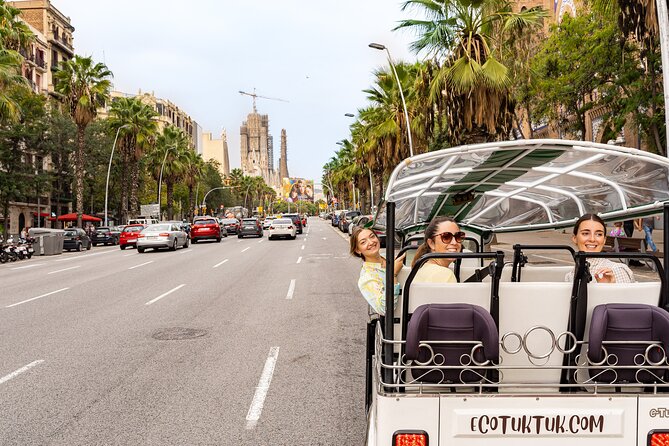
Gaudí in short order, by electric tuk-tuk. This private, 100% electric ride is built for fast sightseeing, with guided stops at major icons and helpful photo moments. I love that you start without queues or waiting, so you spend your time actually seeing Barcelona. One thing to factor in: on the shorter options, there may be limited or no stops, and some canopy designs can partially block your view while you’re listening.
I also like how the tour is practical about weather and comfort. Blankets and protective layers are there for wind or chill, and the driver helps with getting on—useful if you’re traveling with older relatives or anyone who tires easily. The route can shift if streets are closed for the day, so you won’t control every second, but you’ll still get a solid overview.
In This Review
- Key things to know before you go
- Entering Barcelona by Eco Tuk-Tuk: How the 60–240 Minutes Really Works
- Meeting at Carrer de Casp 13: The One Place You Need to Find
- Plaza Monumental de Barcelona: The Bullring Stop That Sets a Tone
- Sagrada Familia: Gaudí’s Cathedral, Still Under Construction
- Casa Milà (La Pedrera) and Passeig de Gràcia: Two Gaudí Masterpieces in One Area
- La Pedrera: A World Heritage Stop
- Passeig de Gràcia: A Showcase Street
- Plaza de Catalunya and Plaza de España: Big Squares, Practical Purpose
- Plaza de Catalunya: The Link Between Old and New
- Plaza de España: Built for 1929 and Still Useful
- Montjuïc and the Old Port: Views and Contrast
- Citadel Park and Arc de Triomf: Exhibition-Era Barcelona
- Ciutadella Park: Old Fortress Grounds Turned into Public Space
- Arc de Triomf: Built for the 1888 Exhibition
- Who This Tour Fits Best (And When to Skip It)
- Price and Value: Is $28.66 Worth It?
- Booking Tips for the Best Experience
- Should You Book This Eco Tuk-Tuk Private Tour?
- FAQ
- How long is the Eco Tuk Tuk Private Tour in Barcelona?
- Is the tour private?
- Is there an English option?
- Where do I meet the driver-guide?
- Does the tour include a guide?
- Is the vehicle electric?
- Are there stops for photos, or is it mostly driving?
- Is hotel pickup or drop-off included?
- Does the tour run in rain or heat?
- What are the age and weight restrictions?
Key things to know before you go
- Electric, private vehicle for your group means less time wrangling and more time watching the city roll by
- No-queue start helps you hit the big sights sooner
- Photo stops are pre-set (you can’t swap them), so the schedule stays smooth
- Blankets and rain protection keep the ride pleasant in cold or wet weather
- Duration changes the amount of stopping: the 60-minute option doesn’t stop for sightseeing time
- Guide quality is a big deal, and many guests highlight how engaging and safe the driving feels
Entering Barcelona by Eco Tuk-Tuk: How the 60–240 Minutes Really Works
This tour is designed like a city orientation, not a slow museum day. You’re in an eco tuk-tuk with a local guide-driver team (an expert companion guide plus the driver), and the goal is to give you an uncluttered view of Barcelona’s key neighborhoods and landmarks without doing nonstop walking.
What you’ll notice right away is how the timing is structured around stop-and-look moments. The tour lasts about 1 to 4 hours, with different versions that change how much you actually get out of the vehicle. The shortest option is the most “drive-through”: the 60-minute tour does not stop, so it’s best for getting your bearings fast. For the longer choices, you’ll have more chances to pause for photos and views.
Also, this is private in the true sense: you share the tuk-tuk only with your group. Vehicles are reserved privately, and the legal maximum is 4 passengers per tuk-tuk, so it doesn’t turn into a crowded bus experience.
You can also read our reviews of more guided tours in Barcelona
Meeting at Carrer de Casp 13: The One Place You Need to Find
Meeting point matters here, because you’re picking up at street level near a car-park elevator. You’ll start at Carrer de Casp, 13 (Eixample), by the Interparking Novedades lift access—opposite the ME Barcelona hotel.
Plan to arrive a little early and look for the entrance elevator area. Your driver-guide comes to that exact spot to pick you up. If anything goes off-script, you can contact the operator by phone or WhatsApp at +34 696 997 889. That contact detail is gold when you’re in a hurry or the streets are busy.
Plaza Monumental de Barcelona: The Bullring Stop That Sets a Tone
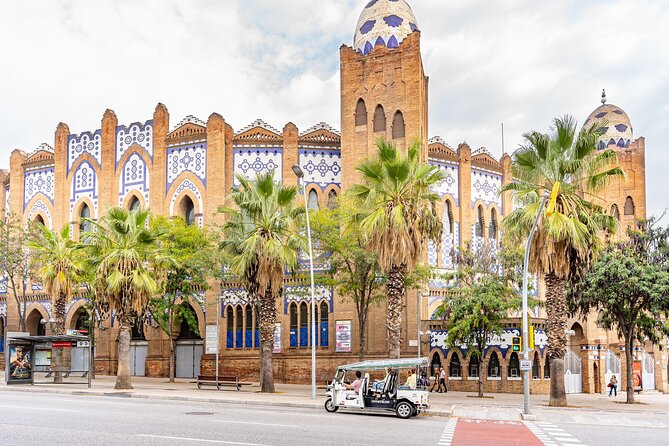
The route begins with a striking landmark: Plaza Monumental de Barcelona, a bullring with deep early-20th-century roots. It opened in 1914 under a different name and was expanded and renamed a couple years later. Even if you’re not thinking about bullfighting, this stop helps you see Barcelona as more than just Gaudí postcards.
From the tuk-tuk, you’ll get a quick sense of the city’s scale and its mix of eras: modernism and today, but also industrial and cultural history that lives right next to tourist icons. The value here is perspective. Barcelona has layers, and this is a way to start noticing them before you head into the Gaudí highlights.
Sagrada Familia: Gaudí’s Cathedral, Still Under Construction

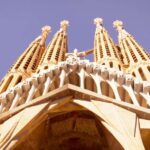
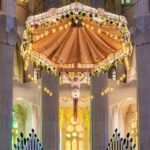
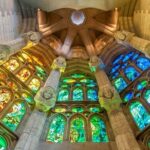
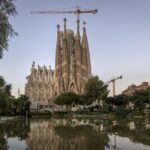
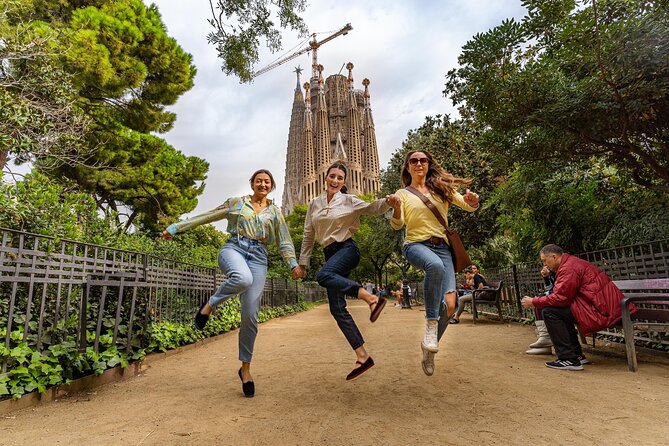
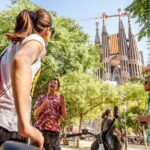
Next is the big magnet: the Expiatory Temple of the Sagrada Familia, known everywhere simply as the Sagrada Familia. Architect Antoni Gaudí began it in 1882, and it’s still under construction—one of the reasons it feels alive rather than finished.
A key benefit of this experience is the promise of starting without queues or waiting. That matters because Sagrada Familia can eat up time even on well-planned days. Even if your time on-site is brief, you’ll still get the context that makes the shapes click: why the design feels so unlike “normal” churches, and how Gaudí’s modernist approach expresses faith through form.
When you’re looking at the building, try to see it as both art and an ongoing project. That mindset makes the sight more memorable—because you’re not only looking at what exists, you’re noticing what’s still being built and why it’s taking this long.
Casa Milà (La Pedrera) and Passeig de Gràcia: Two Gaudí Masterpieces in One Area
If you’re in Barcelona for the first time, you’ll probably hear Gaudí’s name so often it starts to blur. This tour avoids that by grouping Gaudí’s work in a way that helps you compare styles.
You can also read our reviews of more private tours in Barcelona



La Pedrera: A World Heritage Stop
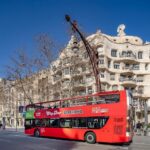
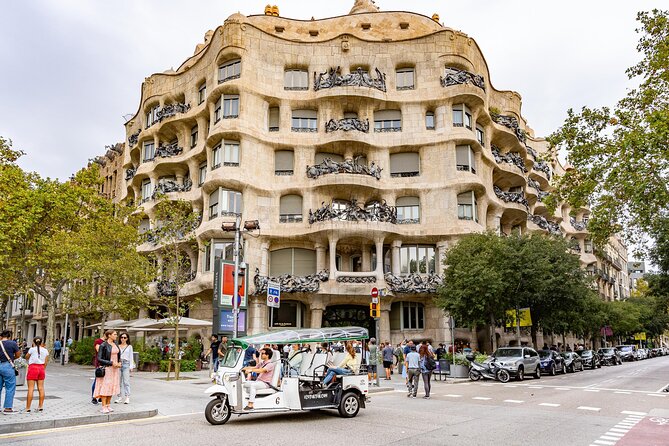
You’ll visit Casa Milà, better known as La Pedrera. Built between 1906 and 1910, it was declared a UNESCO World Heritage Site in 1994. One of the best things about La Pedrera as a “photo stop” is that it reads instantly from the street: the stone-like exterior and sculptural character look like they’ve been carved from the ground rather than placed on it.
The tour also fits well if you don’t have time to do long museum-style visits. You’re getting the “why it’s famous” explanation plus quick visual appreciation.
Passeig de Gràcia: A Showcase Street
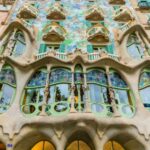
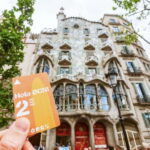
After La Pedrera, you’ll be in the orbit of Passeig de Gràcia, the city’s showpiece boulevard. This stretch is where Barcelona likes to prove a point. The tour itinerary includes a stop for one of the most famous modernist residences on the street: the home designed for the Batlló family by Gaudí.
If your goal is to understand Barcelona’s modernism quickly, this part works because you get the exterior first, then the meaning—so the street doesn’t feel like a random lineup of impressive buildings. It feels like a coherent story.
Plaza de Catalunya and Plaza de España: Big Squares, Practical Purpose
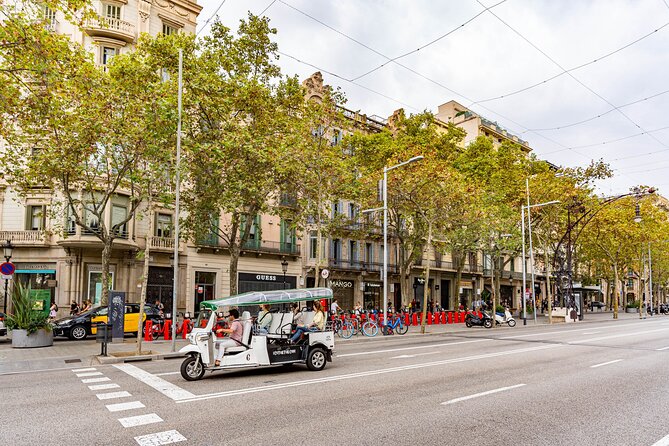
Barcelona’s major squares aren’t just pretty. They’re where the city organizes itself—movement, commerce, and meeting points.
Plaza de Catalunya: The Link Between Old and New
The tour goes through Plaza de Catalunya, the connection between Ciutat Vella and the Ensanche. It’s also a crucial transport hub, where many major streets funnel into one central crossroads. That makes it a smart stop for orientation. From here, you can mentally map how the old city’s streets likely feel, and how the wider Ensanche grid might flow.
Plaza de España: Built for 1929 and Still Useful
Then you’ll see Plaza de España, a major square tied to the International Exhibition of 1929. It was designed through a project by Josep Puig i Cadafalch and Guillem Busquets, and completed by Antoni Darder. Even if you don’t linger long, the explanation helps you understand why it looks the way it does: this is space built to host big events and large crowds, not a small neighborhood plaza.
Montjuïc and the Old Port: Views and Contrast
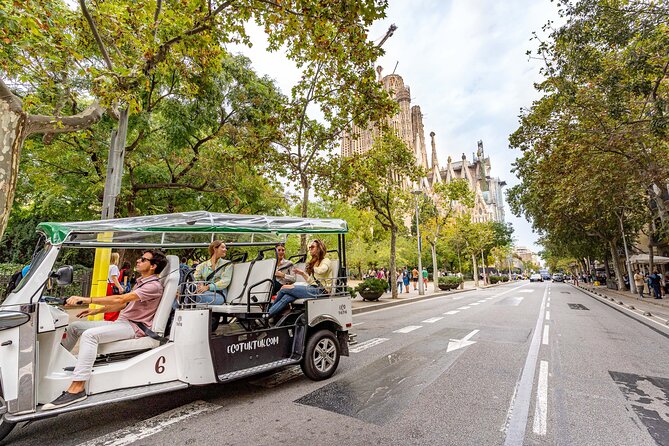
If you choose the longer versions, you’ll add Montjuïc. Montjuïc sits about 177 meters above sea level and comes with a whole neighborhood around it (district Sants-Montjuïc). Even with a short stop, this is one of the best “change of scenery” moments. It helps you see Barcelona from a slightly different angle than the flat street level core.
On this part of the route, the tour aims at photo opportunities and a quick “wow” view—especially helpful if you’re traveling on a tight schedule.
You’ll also head toward the Old Port, the oldest part of the Port of Barcelona. It’s been a working and cultural area for more than two thousand years, separated from the sea by a breakwater. If you like contrasting city styles, the Old Port does it well: it’s classic and historical, but it still functions like a living edge of the city rather than a staged monument.
Citadel Park and Arc de Triomf: Exhibition-Era Barcelona
Two stops bring you into a more park-and-monument mindset: Ciutadella Park and the Arc de Triomf.
Ciutadella Park: Old Fortress Grounds Turned into Public Space
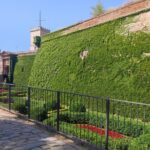
Ciudadela Park sits in the Ciutat Vella district. It used to be the grounds of a fortress, and the park was laid out on that former foundation. The layout was inspired by the Luxembourg garden in Paris, which explains its formal, designed feel.
This is a great “breather” stop on a tuk-tuk day. Even if you don’t walk far, it gives you a calmer view of Barcelona—especially after heavy modernist architecture.
Arc de Triomf: Built for the 1888 Exhibition
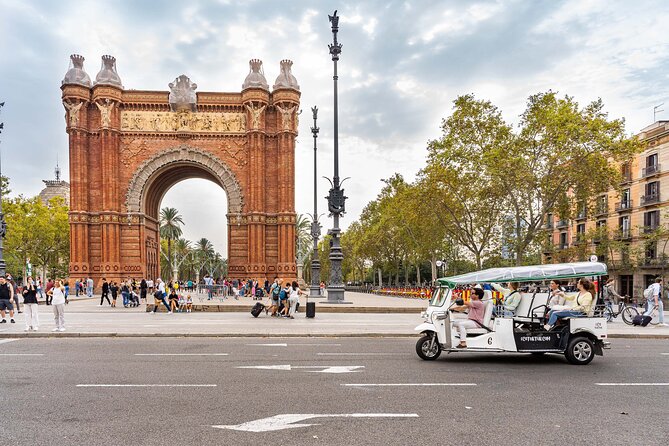
The Arc de Triomf is an 1888-era monument designed by architect José Vilaseca as the main entrance to the Barcelona Universal Exhibition. It’s located at the confluence of major avenues, so it’s easy to spot even when you’re just riding past. This kind of stop is valuable because it shows how Barcelona repeatedly used world-fair style ambition to shape public space.
If you’re the type who likes cities that aren’t just one style, these two stops do the job.
Who This Tour Fits Best (And When to Skip It)
This eco tuk-tuk tour is a strong fit if you:
- want a first-day orientation and a quick feel for neighborhoods
- don’t want to hop on and off buses all day
- have limited time but still want a guided story connecting landmarks
- appreciate comfort measures like blankets and driver help getting on
It’s also a smart choice if mobility is an issue, because the vehicle is described as suitable for older people and the drivers help with boarding.
On the flip side, you might want to think twice if:
- you’re picky about getting lots of time at each monument (this tour is built for short stop-and-see moments)
- you’re sensitive to view obstructions from canopies (one experience highlighted blocked visibility)
- you need to change the stop order or add your own photo stops (the stops for photos are not modifiable)
Price and Value: Is $28.66 Worth It?
At $28.66 per person, what you’re really paying for is time saved and comfort upgraded. This isn’t just a ride; it’s a guided orientation with a private, electric vehicle and pre-set photo moments.
Value usually comes from three things:
- Time: starting without waiting helps you protect your day
- Convenience: you don’t need to plan transport between dispersed sights
- Comfort and climate gear: blankets and protective layers reduce the “we’re cold, let’s quit early” problem
If you’re trying to decide what to do on day one, this tour often works like a map in motion. You’ll leave with a sense of where you want to return—whether that’s Gaudí-focused streets, a park area, or the port side of Barcelona.
Also worth noting: the tour has a 4.8 rating with 1,882 bookings and 95% recommendation in the provided data, which is a useful signal for a tour that depends on guide quality and smooth logistics.
Booking Tips for the Best Experience
A few practical moves can make a difference:
- Pick the right duration for your goal. If you want actual stops and photos, don’t choose the shortest option because the 60-minute tour doesn’t stop.
- Dress for wind. Even with blankets, you’ll be outside enough to feel a chill, especially near the water or on open routes.
- Know that the route may shift due to closed streets or demonstrations. That’s normal in big cities; the tour adapts, but you won’t control the change.
- If you’re concerned about visibility from a canopy, be ready for that possibility. Ask where you’ll have the best sightlines once you’re settled.
Should You Book This Eco Tuk-Tuk Private Tour?
I’d book it if you want a guided, comfortable overview of Barcelona that doesn’t waste your day stuck in transit. It’s especially appealing if you’re doing Barcelona for the first time and want to connect dots between Sagrada Familia, Passeig de Gràcia, major squares like Plaza de Catalunya and Plaza de España, plus the port and city-exhibition era sights.
I’d hesitate if your main goal is deep time at monuments, because this format is built for short stops and photo windows, not long independent exploring. And if you’re very sensitive to view-blocking canopy structures, choose your timing and seating thoughtfully.
If your plan includes picking a few priorities for the next day, this tour can be a smart first step.
FAQ
How long is the Eco Tuk Tuk Private Tour in Barcelona?
It runs for about 1 to 4 hours, depending on the selected duration.
Is the tour private?
Yes. This is a private tour/activity, and only your group participates.
Is there an English option?
Yes, the tour is offered in English.
Where do I meet the driver-guide?
You meet at Carrer de Casp, 13 (Eixample, 08010 Barcelona) near the elevator lift access to the Interparking Novedades car park, opposite the ME Barcelona hotel.
Does the tour include a guide?
Yes. It includes an expert companion guide driver.
Is the vehicle electric?
Yes. The tuk-tuks are described as 100% electric and sustainable.
Are there stops for photos, or is it mostly driving?
There are pre-selected stops for shooting, and the amount of stopping depends on the tour length. The 60-minute tour does not stop, while longer options include additional stop moments.
Is hotel pickup or drop-off included?
No. Hotel pickup and drop-off are not included.
Does the tour run in rain or heat?
The tour takes place in rain or heat, and it can only be cancelled under extreme conditions.
What are the age and weight restrictions?
The minimum age is two (2) years, and babies are not allowed. There is also a minimum weight requirement of 9 kg.