REVIEW · BARCELONA
Tarragona and Sitges Small Group Tour – Roman History & Culture
Book on Viator →Operated by Explore Catalunya · Bookable on Viator
A Roman bridge plus a beach break sounds like a perfect day. This full-day, small-group route pairs the Roman power of Tarragona with the relaxed seaside vibe of Sitges, and you do it all without the stress of trains and transfers.
I especially like the mix of guided walking and real free time. Tarragona’s big Roman hits get explained clearly, and then you get breathing room later to wander Sitges’ streets, pop into cafes, and even cool off in the Mediterranean.
One possible drawback: it is a packed day. If you’re hoping for long, slow museum-style time in one place, the schedule moves on, and Sitges can feel busy depending on the day.
In This Review
- Key points worth knowing before you go
- A Roman-and-Beach Day That Actually Feels Balanced
- Getting There: The 8:30am Meet and the Comfort Factor
- Pont del Diable Aqueduct: Walking the Devil’s Bridge
- Tarragona Old Quarter: Forum, Circus, and the Cathedral Area
- A Roman-Style View Break at Roc de Sant Gaieta
- Sitges Beaches and Streets: Where Time Becomes Yours
- What the Small Group Actually Changes
- Price and Value: Is $119.48 a Good Deal?
- Timing Reality: A Full Day With Smart Breaks
- What to Pack (So the Day Doesn’t Fight You)
- Who This Tour Fits Best (and Who Might Prefer Something Else)
- Quick Bottom Line: Should You Book Tarragona and Sitges?
- FAQ
- What time does the tour start and where do I meet?
- How long is the tour?
- What transportation is included?
- Is hotel pickup included?
- Is the tour in English?
- How big is the group?
- Do I get time for the beach or swimming in Sitges?
- Are entrance fees included?
- Where does the tour end?
Key points worth knowing before you go
- Pont del Diable Aqueduct walk: You can cross the top for that wow moment over 2,000 years old.
- Tarragona’s Roman + medieval overlap: You’ll see modern streets sitting right on top of ancient city layers.
- Forum and Circus viewpoints in town: Roman ruins are built into everyday urban squares and passages.
- Roc de Sant Gaieta quick stop: Short, scenic break with rocky shoreline charm.
- Sitges time for beach and browsing: Plan for both swimming and wandering, not just photos.
- Small group pacing: The tour keeps you moving, but with enough attention that questions don’t feel rushed.
A Roman-and-Beach Day That Actually Feels Balanced
This is the kind of tour that fixes a common Barcelona problem: you can either do a heavy history day or a pure beach day. Here, you get both, and they’re connected in a way that makes sense. Tarragona brings the Roman backbone. Sitges brings the coast life.
What makes this route work is that it doesn’t treat Tarragona as a checklist. You walk through real city space—old quarters, squares, and viewpoints—so the Roman remains feel like they belong to the place, not like something dropped in for tourists.
Then Sitges takes over with whitewashed streets, cafe stops, and shopping time. You’ll feel the shift from stones and aqueduct angles to salt air and easy strolling.
You can also read our reviews of more historical tours in Barcelona



Getting There: The 8:30am Meet and the Comfort Factor
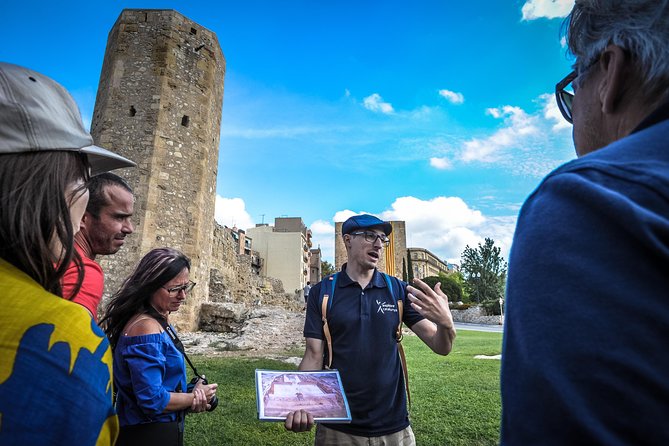
Your day starts early. You’ll meet at C/ Palau de la Música, 1 (right near the famous concert hall area), then wait a bit while the guide handles logistics and gives a quick outline of what’s next.
The group heads out around 8:30am by air-conditioned minivan. That matters more than it sounds. The drive to Tarragona is about 90 minutes, so having a small, comfortable vehicle helps you arrive not fully cooked by Barcelona traffic.
Also, the tour is in English only, and the group size is kept small. In practice, that means you’re less likely to get lost in a crowd every time you stop for an explanation.
Pont del Diable Aqueduct: Walking the Devil’s Bridge
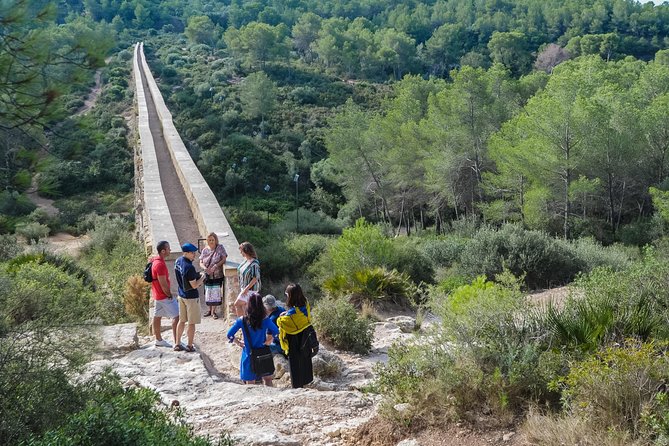
At around 10:00am, you reach the highlight that most people picture when they think Roman Spain: the aqueduct called Pont del Diable (also known as Les Ferreres).
Here’s what makes this stop special for your day. It’s not just seeing the structure from below. You can walk across the top, crossing from one side to the other. Standing where the water supply once moved through the city gives you a rare scale sensation. You’re up high, you’re looking at the terrain below, and you’re literally moving along an almost perfectly preserved relic.
It’s also quick enough that you don’t feel like you spent the morning stuck in one spot. You get that big “wow,” then you move on to the denser, more walkable parts of Tarragona.
Practical tip: wear shoes you trust. You’re on an outdoor structure, and your pace here sets the tone for the rest of the day.
Tarragona Old Quarter: Forum, Circus, and the Cathedral Area
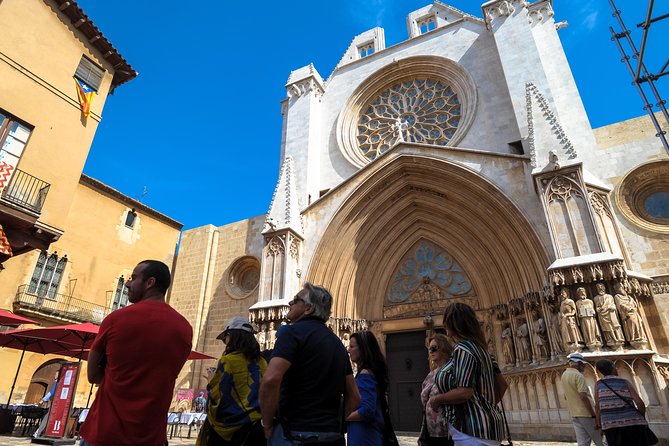
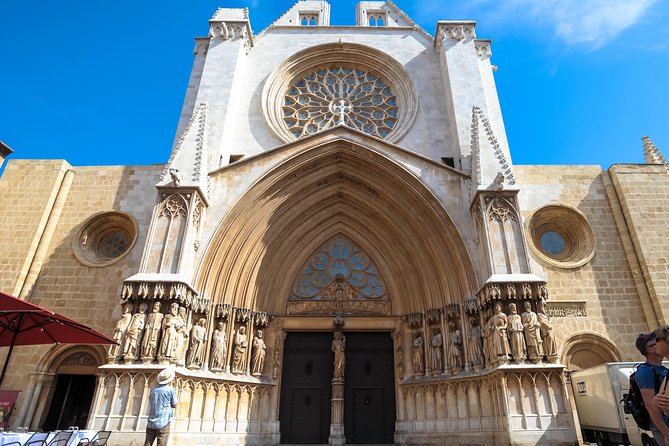
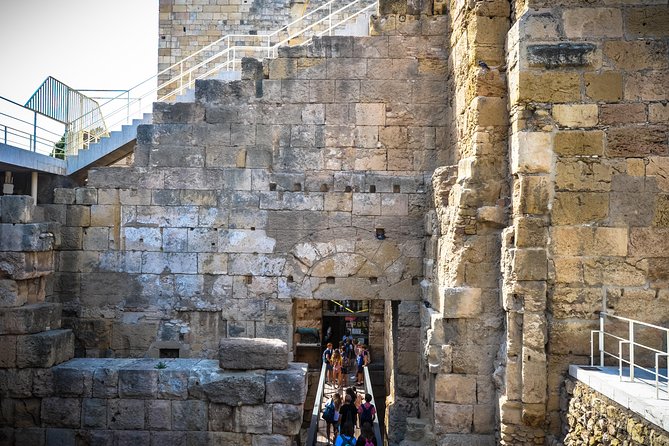
Around 11:00am, you enter Tarragona through old city walls, into the area where the modern town overlaps the ancient one. That overlap is the point. You’re walking in a real neighborhood, not circling fenced-off ruins.
Your route includes:
- the archaeological walkway and surviving stone areas
- the Old Quarter with its medieval layers (including a medieval hospital you pass by)
- the cathedral area, where there can be a Sunday morning antique market
- a walk down toward the Roman Forum
- the nearby Roman Circus, tucked into the urban design
One of the most intriguing parts is how the Roman Circus is supported by architecture you can actually see in the city today. You’ll even find underground passageways connected with the circus stands. The idea is simple, but the effect is strong: you’re not just looking at remnants; you’re moving through spaces that still feel like part of the original system.
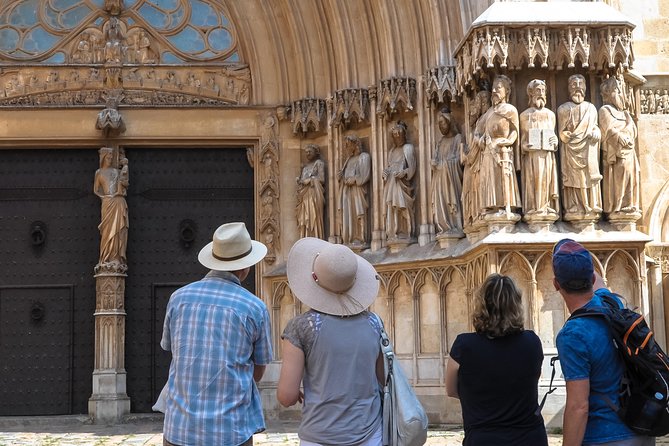
There’s also a standout viewpoint moment in the sequence. You’ll pause near a square inside the Roman Circus area (Placa de la Font), where the setting makes you picture chariots and crowd noise even if you can’t literally hear it.
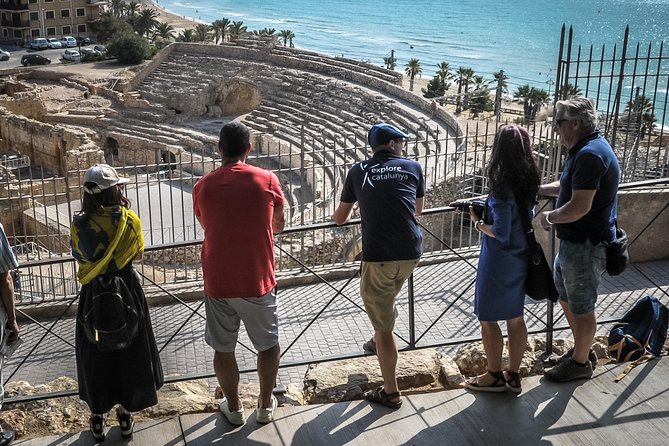
And yes, the amphitheater area is dramatic: you get a seafront view and a sense of what the stage environment was like long ago, including the surprising reuse of building blocks in a later Christian church built in the middle of the stage.
Time-wise, this segment runs about 2 hours, with walking plus explanations plus chances to look around.
A Roman-Style View Break at Roc de Sant Gaieta
On the way to Sitges, you stop briefly around 1:30pm at Roc de Sant Gaieta. This is a small coastal spot with tiny white houses along a rocky shoreline.
It’s only about 20 minutes, so treat it like a palate cleanser. You’re not here for a full exploration. You’re here to step out, take in the sea angle, and let the vibe reset before you shift to Sitges.
If your brain needs a transition from Roman stone logic to Mediterranean daydreaming, this stop does the job.






Sitges Beaches and Streets: Where Time Becomes Yours
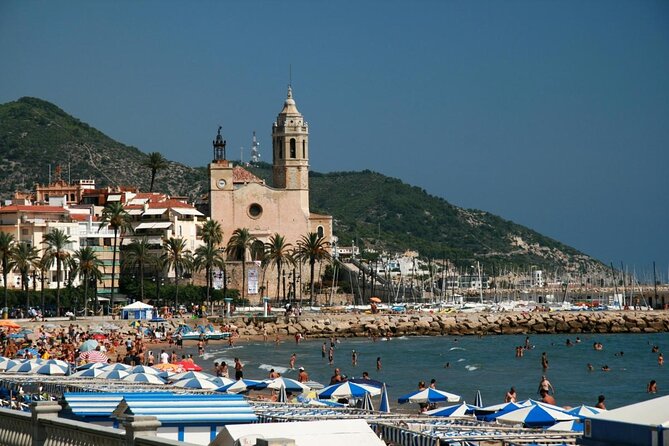
Around 2:30pm, you arrive in Sitges, a former fishing village that turned into a popular coastal town. You’ll have roughly 3 hours here, and this is where the tour turns from guided to flexible.
Sitges is built for wandering:
- long sandy beach time (and optional swimming)
- shaded streets and whitewashed architecture
- cafes and restaurants along the seafront
- boutiques and shop streets for casual browsing
You can also use your time however you want. Some people focus on the beach. Others do a slow walk through side streets first, then land by the water for food or a drink.
Two practical notes help you enjoy this part more:
- You’ll likely want to eat in Sitges, but you should plan your lunch around the time you have. The tour leaves Sitges around 5:30pm, so don’t get stuck somewhere you can’t easily escape.
- If you’re visiting on a day when crowds are higher, Sitges can feel busy. The flip side is that it’s lively and there are plenty of options.
If you want the swim option, bring a swimsuit and a beach towel. The tour explicitly allows for swimming time if you want it.
What the Small Group Actually Changes
This tour keeps the group small—explicitly capped at a maximum of 8 travelers. That shows up in everyday moments.
You’re not one face in a sea. You can hear your guide’s explanations without constantly craning your neck, and you can ask questions when you see something confusing like a Roman structure connected to a later building.
It also makes transitions easier. When you arrive somewhere new—like Pont del Diable or the Forum area—you don’t lose time herding people in the wrong direction.
Guide style matters too, and the group tends to benefit from guides who can talk history in a way that feels practical rather than like a lecture. Names that come up often include Sergio, Rod, Xavier, Henrique, Steven/Steve, Jordi, and Enrique. Different personalities, but a consistent theme: your day stays interesting and organized, with enough time to ask follow-up questions.
Price and Value: Is $119.48 a Good Deal?
At $119.48 per person, you’re paying for a lot of practical things at once: a professional guide, air-conditioned minivan transport, and a day that stitches together two separate towns without you doing the planning.
Value shows up in three ways:
- You get to see Pont del Diable and the Roman core of Tarragona without figuring out how to connect everything on your own.
- You get guided context at the places that could otherwise feel like random stones.
- You still get free time in Sitges, so you’re not stuck in a constant museum rhythm.
One small caution on costs: entrance fees for museums and monuments in Tarragona are listed as not included. That doesn’t automatically mean you’ll pay at every stop, because some key sites are presented as ticket-free walk areas, but you should still keep the “possible extra costs” idea in mind for any optional entry.
Timing Reality: A Full Day With Smart Breaks
This is a 10 hours 30 minutes day in the neighborhood of what you’d expect from a two-city itinerary. You’ll start at 8:30am and you’ll return around 7pm, ending near Plaça de Catalunya.
The rhythm is what makes it work:
- a drive early so you start exploring while the day is fresh
- a big Roman aqueduct stop in the late morning
- a dense Roman walking block with plenty of viewpoints and breaks
- a short scenic stop before the beach town
- a leisure-focused afternoon where you control your own pace
If you get motion-sick or you hate long seated time, this may feel like a lot. But the minivan helps, and you have multiple opportunities to get your legs moving.
What to Pack (So the Day Doesn’t Fight You)
The tour guidance is clear: bring comfortable footwear and sun protection. That’s not generic advice. Your day includes outdoor walking on warm surfaces and open-air views.
Also:
- If you plan to swim in Sitges, bring a swimsuit and towel.
- Dress in layers. Coastal weather can shift, and Tarragona has open viewpoints where the sun can feel strong.
A tiny piece of strategy: do your Sitges shopping or cafe stops with your departure time in mind. It’s easy to lose 20 minutes in a side street when the vibe is good, and the tour leaves on schedule.
Who This Tour Fits Best (and Who Might Prefer Something Else)
This tour is a great fit if you:
- want Roman ruins but also want a coast break
- prefer a small-group feel over large coach tours
- like having guided context at the big sites, then free time to roam
You might look at alternatives if you:
- want long museum time in one place (this day spreads across Tarragona and Sitges)
- dislike busy waterfront towns on crowded days
- need hotel pickup (this tour doesn’t include it)
Families with older kids can do it too, but it’s noted as not recommended for children 4 and under.
Quick Bottom Line: Should You Book Tarragona and Sitges?
I’d book this tour if you’re excited by the idea of walking across an ancient aqueduct and then spending the afternoon in a real seaside town with time to relax. The value is in the combination: Roman Tarragona morning, sea views and a coastal reset at Roc de Sant Gaieta, and then Sitges with genuine downtime.
If you’re the type who wants to linger, you can still enjoy this. Just go with the right mindset. Think of it as a “best-of” Roman day plus a beach reset, not a slow, deep study of one site.
FAQ
What time does the tour start and where do I meet?
You meet at C/ Palau de la Música, 1, Ciutat Vella, 08010 Barcelona. The start time is 8:30am.
How long is the tour?
The tour runs about 10 hours 30 minutes (approx.).
What transportation is included?
You travel by air-conditioned minivan.
Is hotel pickup included?
No. Hotel pickup and drop off are not included.
Is the tour in English?
Yes. The tour is English only.
How big is the group?
This tour has a maximum group size of 8 travelers.
Do I get time for the beach or swimming in Sitges?
Yes. You’ll have time in Sitges, and the tour notes that there’s an opportunity to go swimming. Bring a swimsuit and beach towel if you want to swim.
Are entrance fees included?
Entrance fees for museums and monuments in Tarragona are not included, though several major stops are listed as ticket-free walk areas.
Where does the tour end?
The tour ends in Plaça de Catalunya (around 7:00–7:15pm), where you can use metro or taxi services.