REVIEW · BARCELONA
City Sightseeing Barcelona Hop-On Hop-Off Bus Tour: 24 or 48-Hour
Book on Viator →Operated by City Sightseeing Ltd - Europe · Bookable on Viator
Get your Barcelona bearings from the top deck. This hop-on hop-off bus tour turns a chaotic city into a simple loop of viewpoints, with open-top 360-degree views and audio that keeps you oriented as you travel. My one real warning: the starting area at Plaça de Catalunya can be confusing if you’re not sure which stop you’re looking for.
What I love most is the flexibility. With unlimited hop-on hop-off for 24 or 48 hours, you can ride the big sights first, then come back later when your feet have a say. The coupon booklet (over €200 in discounts at top attractions) is the kind of extra that can quietly make the tour feel like a bargain.
One more practical note before you go: it’s built around a bus rhythm, so expect the schedule to be influenced by traffic and the city’s stop-and-go pace. Still, if you time it right, it’s a very efficient way to see a lot without feeling like you’re constantly transferring lines.
In This Review
- Key Things to Know Before You Ride
- The big-picture value: 24 or 48 hours plus two routes
- Red vs Blue: how to choose the right circuit for your day
- Plaça de Catalunya to Passeig de Gràcia: your orientation starts here
- Eixample, Sants, and the museum-style stops you’ll actually use
- Montjuïc and the Olympic zone: cable car access and museum time
- Las Ramblas to Colom, then the coast: where the city changes gears
- World Trade Center, Forum, and the modern shoreline stops
- Sagrada Família and the Arc de Triomf link: two iconic anchors
- Blue route highlights: Sant Pau, Park Güell area, Tibidabo, and more
- Riding tips that actually matter: photos, Wi‑Fi, and rough weather reality
- Where time slips away: stop hunting, traffic, and the “full loop” myth
- Price and value: is $39.54 worth it?
- Should you book this hop-on hop-off bus in Barcelona?
- FAQ
- How long is the City Sightseeing Barcelona hop-on hop-off tour?
- What are the first and last bus departure times?
- How often do buses run?
- Do I need to choose between 24 hours and 48 hours?
- Does the pass include admission to attractions?
- What onboard features are included?
- What is the cancellation policy?
Key Things to Know Before You Ride

- Two routes (Red and Blue) for covering different sides of Barcelona
- 24- or 48-hour pass so you can pace your day instead of rushing it
- Free Wi‑Fi and 16-language audio delivered through provided headphones
- Buses depart from major stops near the sights, so walking time stays reasonable
- Pink and blue Bus Turistic vehicles make them easier to spot in traffic
- Coupon booklet with €200+ in discounts can add value if you already planned big-ticket stops
The big-picture value: 24 or 48 hours plus two routes

Barcelona is wide. It’s also full. A hop-on hop-off bus makes sense here because it solves two problems at once: distance and decision-making. Instead of guessing which neighborhood to start in, you get a moving map. Sit up top, take in the skyline and street layouts, and let the route point you toward what you actually want to do on foot.
This is the kind of tour where the real win is pacing. A 24-hour pass works well if you’re doing a quick first look and want a second day of exploring on your own. A 48-hour pass is better if you want to revisit favorites, especially around the big anchor zones like Sagrada Família, the coast, and Montjuïc.
Also: the tour is positioned as a 120-minute ride experience. In practice, if you hop off and back on (which is the whole point), your total day expands. But that’s not a downside. It’s why this tour fits both a short stay and a slower itinerary.
You can also read our reviews of more city tours in Barcelona

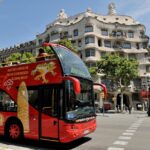

Red vs Blue: how to choose the right circuit for your day

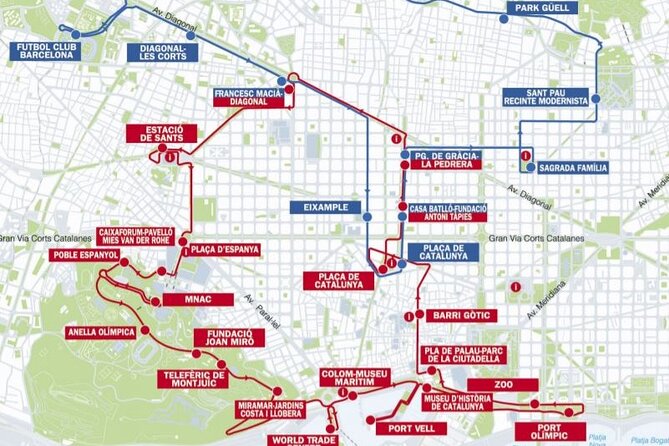
You get access to two bus routes—commonly referred to as Red and Blue—and you can use your pass on both. Here’s how I’d choose:
- Pick Red if you want more of the connection between the central city, Sagrada Família, and the longer stretch toward the port and beaches.
- Pick Blue if you want a different set of highlights, including stops that make it easy to reach areas linked with major modern architecture and viewpoints.
A simple strategy that works: ride the route closest to where you’re staying first (or the one you can board quickest), stay on long enough to understand the spacing between stops, then decide where you want to hop off next. With two routes, you’re not stuck doing everything in one loop.
And yes, the buses can feel like they’re doing a lot of “city driving.” That’s the point. You’re buying orientation. You’re buying convenience. And you’re buying a way to plan without constantly checking your phone while walking across busy intersections.
Plaça de Catalunya to Passeig de Gràcia: your orientation starts here
Most days begin at Stop 1: Plaça de Catalunya, which sits at the center of the city’s sightseeing gravity. If you’re trying to be efficient, this is a great place to start because you’ll quickly see which directions are easiest to reach.
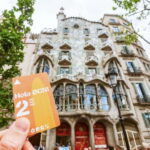
From there, one of your key central stops is Passeig de Gràcia, with the tour naming Casa Batlló and Fundació Antoni Tàpies in that stretch. Staying on the bus here gives you a strong visual “corridor” for future walking. If you hop off, you’re basically placing yourself in the middle of the kind of Barcelona shopping-and-stroll streets people remember.
On the Blue route specifically, you’ll also see Passeig de Gracia – La Pedrera. That’s an easy hop for getting close to one of the city’s famous modernist landmarks without having to wrestle with transit transfers.
You’ll then continue through Eixample (the tour calls out Avinguda de Roma, 3 on one route and Av. Roma – Tarragona on the other), which is a helpful way to understand how Barcelona’s grid spreads out. If your goal is not just seeing big names but getting your bearings for where everything sits, these middle-city stretches matter.
Eixample, Sants, and the museum-style stops you’ll actually use
If you like your sightseeing to be a mix of views and practical walkability, don’t ignore the stops that look less famous from a brochure. They’re often the most useful for timing.
On one route you’ll get stops around the Eixample area, then down to Estació de Sants. Even if you’re not taking a train, this stop helps you understand the city’s transit spine. It’s also handy if your schedule changes and you need a convenient landmark to regroup.
You’ll also see Plaça d’Espanya – Fira Barcelona. This is a big reference point for reaching larger attractions in the south-west part of the city. Nearby, the tour includes CaixaForum – Pavello Mies Van der Rohe and Poble Espanyol. That combo is ideal if you’re trying to balance an architecture-and-design vibe with something more hands-on and stroll-friendly.
Montjuïc and the Olympic zone: cable car access and museum time
Montjuïc is where the bus gives you more than a photo moment. It helps you get to the hill without losing half a day to transit.
On the route, you’ll pass by Museu Nacional d’Art de Catalunya and the Anella Olímpica area. These stops are great if you want museum time plus viewpoint wandering. Next, the tour highlights Av Miramar – Fundació Joan Miró and also includes Telefèric de Montjuïc (Montjuïc Cable Car). That cable car stop is especially useful because it’s one of the easiest ways to connect the bus route with higher-elevation views.
You’ll also get more “Miramar area” stops, including Miramar – Jardins Costa i Llobera. One practical tip: if you’re going later in the day, bring layers. Reviews include the reality that wind can be a problem on the top deck, and Miramar-type areas can feel cooler than the city center.





Las Ramblas to Colom, then the coast: where the city changes gears

A classic Barcelona experience is moving from dense center streets to sea air. The bus helps you do that smoothly.
On one route, you’ll see La Rambla – Colom. That’s your direct connection to the famous walking artery (and the end of it toward the harbor). Staying on for a while lets you see how the buildings, street patterns, and foot traffic shift as you near the water.
Then you continue to Museu d’Historia de Catalunya, followed by Port Olímpic. This is one of the most practical “hop off and stretch your legs” areas on the tour. From there, the route keeps going along the coast to beach zones: Platja del Bogatell and Platja Nova Mar Bella.
If beaches are on your wish list, this is the low-effort way to reach them. You don’t have to navigate buses and metros while your mood is already set to relax. You just ride, hop off, and decide how long you stay.
World Trade Center, Forum, and the modern shoreline stops
Past the big postcard zones, you’ll still have a lot to do if you like modern Barcelona.
The first route names a stop at World Trade Center, then continues to Forum and Parc Diagonal Mar. After that, you’ll roll into Poblenou and reach Torre Glòries (at Pl de les Glòries). This section is useful because it gives you a clean sense of how Barcelona expanded outward and how neighborhoods changed their look over time.
If you’re the type who wants photos of more modern architecture and wider streets, don’t treat this as “just getting to the beach.” The shoreline-to-neighborhood stretch is a big part of why the bus works: it saves you from long cross-city hikes.
Sagrada Família and the Arc de Triomf link: two iconic anchors

On one route, Plaça de la Sagrada Família is a major stop. From the bus, you’ll get the famous sight from street level, and it’s a very natural hop-off point for planning a timed entry later on your own. The tour overview also points to Sagrada Familia, designed by Antoni Gaudí, so you’re not guessing why this stop matters.
On the same route list, you’ll also see Barcelona Bus Station North and Arc de Triomf. That arc-and-station combo is great for returning toward central areas without feeling like you’re walking back from the edge of town.
Blue route highlights: Sant Pau, Park Güell area, Tibidabo, and more
Blue route stops include a lot of “big decision” sights, which is perfect for a first trip.
After starting near central Plaça de Catalunya, Blue includes Casa Batlló again, plus Passeig de Gràcia – La Pedrera. Then you’ll reach Sant Pau Recinte Modernista (the tour calls it out at Carrer de Cartagena, 329). If you’re into strolling near impressive facades and want an attraction stop that’s easy to combine with a bus-and-walk plan, this is one of the best uses of your pass.
Next comes Park Guell. Then there’s a stop for Tramvia Blau – Tibidabo and an area called Sarria. The tour also names Monestir de Pedralbes and Palau Reial – Pavellons Güell. Those clusters make the Blue route especially useful if you want a mix of viewpoints and walkable compounds without planning a full day of transit.
The route continues with a stop for Futbol Club Barcelona, then Diagonal – Les Corts and Francesc Macia – Diagonal. Finally, it reaches Eixample again (at Av Roma – Tarragona), and ends with Sant Antoni (via Gran Via – Viladomat). The benefit is simple: it gives you options across multiple neighborhoods without requiring you to choose only one area.
Riding tips that actually matter: photos, Wi‑Fi, and rough weather reality
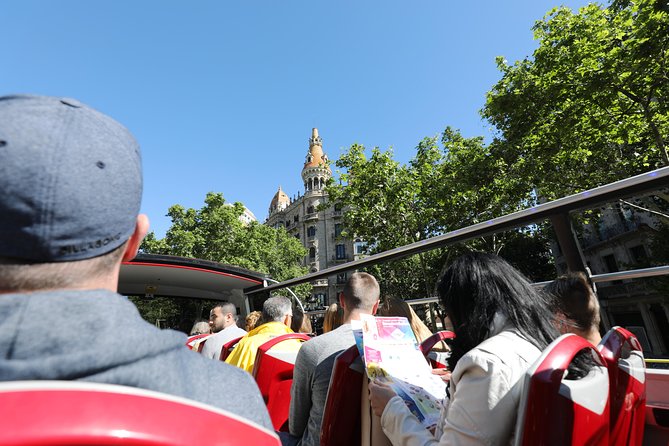
The bus experience is straightforward. It’s double-decker, open-top, and designed for 360-degree views. The tour also includes free Wi‑Fi plus an audio guide in 16 languages with headphones.
Here’s how to use that smartly:
- If you care about photos, try the top level when weather allows. One big reviewer win was that the open-air top made it easier to take pictures and look around.
- If it’s windy or rainy, plan to wear something that blocks wind. Reviews include a painful reminder that covered tops don’t always protect your sides.
- Keep your headphones handy, and treat them as part of your comfort kit. The audio is a big part of why this is more than just sightseeing from a seat.
One accessibility note from real experiences: one rider reported that the provided earphones didn’t fit well over certain hearing aids (CIC and ITE types). If you use hearing aids, it’s worth thinking ahead about whether the standard headphones will work for you, or whether you’ll need an alternative way to listen.
Also, a small but real quality issue can happen. Some reviews mention dirty windows, which can ruin photos from certain angles. If photos are your priority, wipe your expectations down: try to shoot from open areas or switch decks when you can.
Where time slips away: stop hunting, traffic, and the “full loop” myth
This tour is built to help you move. But it doesn’t remove Barcelona’s real-world friction: traffic lights, congestion, and crowded intersections.
Even when the buses are frequent (the tour information says departures are every 20 minutes, and also notes very frequent service in high season), you’re still riding through a busy city. One review experience mentioned that completing a circuit took longer than expected due to traffic. Another mentioned timing issues around the final departure.
So plan like this:
- Do your most important hop-off stops earlier in the day.
- Don’t treat “last bus” as a suggestion. Know the stated last departure time is 7pm from Stop 1.
- Leave extra time to find the correct stop—especially around Plaça de Catalunya, where people reported confusion about where to start.
If you want a smooth day, use the bus as your backbone, not your only plan.
Price and value: is $39.54 worth it?
At $39.54 per person, you’re paying for more than a ride. You’re paying for:
- 24 or 48 hours of transportation across two routes
- access to stops near major sights so you can walk from the bus instead of figuring out multi-transfer routes
- audio in 16 languages and onboard Wi‑Fi
- a coupon booklet with over €200 in discounts
Value depends on your style. If you’re the type who likes to pick a few big sights and spend the rest walking, a bus pass can feel like money well spent because it reduces transit time between neighborhoods. If you’re already staying near everything and plan to walk all day, the bus can still help, but it’s less “must-have.”
Where I think it shines is when your itinerary is flexible. The hop-on/off design means you can adjust mid-day based on lines, weather, and energy. And if you actually use some of those discounts, the coupon book can soften the cost.
Should you book this hop-on hop-off bus in Barcelona?
Book it if:
- You want a fast way to see lots of neighborhoods without mapping a route in your head.
- You like the idea of 24 or 48 hours so you can revisit what you liked.
- You’d benefit from audio in multiple languages while moving around the city.
Skip it or think twice if:
- You hate weather exposure and plan to spend a lot of time on the open top in questionable conditions.
- You strongly prefer a totally self-guided walking approach and are already staying near your target sights.
- You depend on hearing-aid compatibility with standard headphones and want zero risk.
If you fall into the first group, this is one of the simplest ways to get your Barcelona footing fast—especially when you use it like a tool for planning, not just a loop to sit through.
FAQ
How long is the City Sightseeing Barcelona hop-on hop-off tour?
The ride is listed as about 120 minutes. Since it’s hop-on hop-off, your total time in the experience depends on how often you get off and reboard.
What are the first and last bus departure times?
Buses depart from Stop 1 at 9:00am and the last bus departs at 7:00pm.
How often do buses run?
The tour information says buses run with a frequency of about every 20 minutes. There are also notes that the service is very frequent in high season to reduce waiting.
Do I need to choose between 24 hours and 48 hours?
Yes. You can choose a 24-hour or 48-hour pass, and the ticket allows unlimited hop-on hop-off during that validity window.
Does the pass include admission to attractions?
No. The bus tour includes transportation and the onboard experience, but entry to attractions is not included.
What onboard features are included?
You get free Wi‑Fi and an audio guide in 16 languages with headphones.
What is the cancellation policy?
Free cancellation is available. You can cancel up to 24 hours in advance for a full refund; cancellations within 24 hours aren’t refunded.