REVIEW · BARCELONA
Gothic Quarter – Private Tour
Book on Viator →Operated by Be Local Tours · Bookable on Viator
One wrong turn and you’re in 2,000 years. This private Gothic Quarter tour strings together Roman remains, medieval streets, and major churches into a walk that makes the whole neighborhood feel connected. You get an English-speaking local guide and a clear route that helps you read the city instead of just taking photos.
I especially love the storytelling style from guides like Carlos and Patrick, who keep the focus on what each place meant and how Barcelona got where it is today. I also like the practical pacing flexibility you can feel during the walk, including for families and even for slower walking speeds, so nobody has to jog for the next stop.
One thing to consider: you’ll be walking a lot on uneven old-stone streets, and finding your guide at the large Plaça de Catalunya meeting area may take a few minutes. Plan for extra time at the start, and rely on the guide’s company card and any clear meeting instructions.
In This Review
- Key Highlights at a Glance
- Starting at Plaça de Catalunya: get oriented fast
- Rambla to medieval lanes: learning the neighborhood’s grammar
- Roman burial site and Barcino remains you can actually picture
- Churrerías street flavor: the Gothic Quarter beyond monuments
- A Catalan Gothic church stop: why 14th-century details matter
- Jewish Quarter alleys: medieval streets with a serious past
- Hidden square and Civil War scars: history you can see
- Neo-Gothic bridge symbols: spotting meaning in odd details
- Catalonia’s power center: the medieval palace and civic squares
- Santa Creu and Santa Eulalia: neo-Gothic façade over medieval structure
- Price and value: is $66.52 worth 2.5 hours?
- Who this private Gothic Quarter tour fits best
- Booking check: should you choose this one?
- FAQ
- FAQ
- How long is the Gothic Quarter private tour?
- Is this tour private?
- Do you offer pickup?
- Where does the tour start and end?
- What language is the tour in?
- Is transport included?
- Can I cancel for a refund?
- Is good weather required?
Key Highlights at a Glance
A single neighborhood, layered through time (Roman to neo-Gothic)
English local guide with lots of history stitched to real street corners
Private pace that works for families and slower mobility
Major landmarks plus quieter stops like hidden squares and back-street views
Playful, kid-friendly details alongside serious architecture and politics
Pickup available within 0.5 km of Plaça de Catalunya
Starting at Plaça de Catalunya: get oriented fast
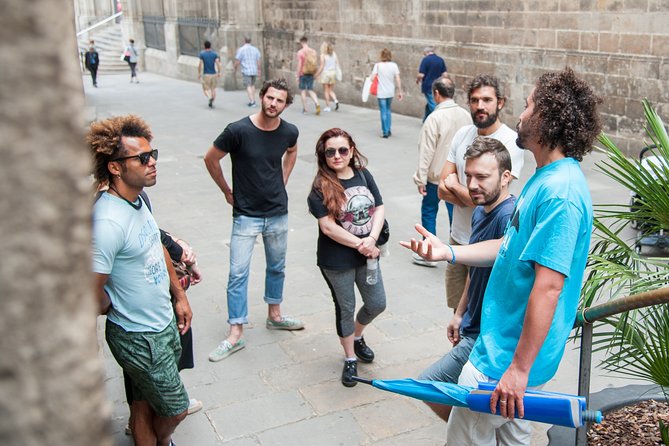
This tour starts in the Eixample side at Plaça de Catalunya. It’s a huge square, so give yourself a small buffer and don’t assume the guide will be easy to spot at first glance. The good news: the guide carries a company card, and you’ll have a consistent end-of-tour place in Ciutat Vella around Pl. de Correus (near Sant Jaume Square).
I like this setup because you’re launching from a major transit hub, which means you’re not scrambling to reach some random back entrance. It also helps if you’re coming from another part of Barcelona and want to keep the morning (or afternoon) smooth.
If you’re the type who hates being lost even for five minutes, you’ll probably appreciate that the guide experience includes extra help with meeting points (one guest described getting exact directions and photos ahead of time). Still, in a plaza this large, I’d rather you show up early than stress.
You can also read our reviews of more private tours in Barcelona


Rambla to medieval lanes: learning the neighborhood’s grammar
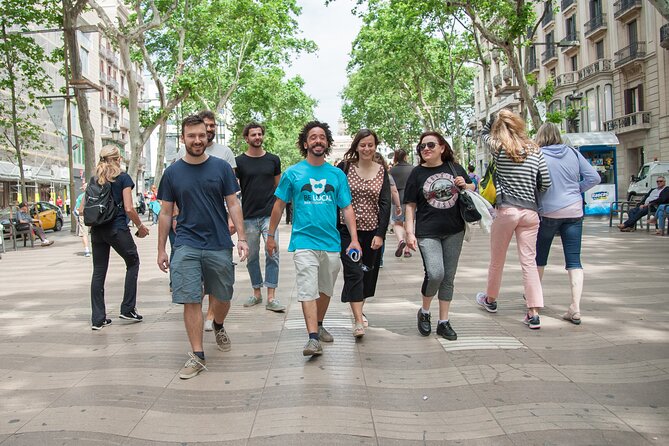
The walk begins with the Rambla, Barcelona’s famous avenue. Even if you’ve seen it before, this is a smart way to start because it gives you context for what you’re looking at later: a city that’s layered, political, religious, and commercial all at once.
From there, you move into the medieval narrow streets of the Gothic Quarter, where you’ll see churches and palaces from different periods stacked together. This is where the guide’s approach really matters. Instead of rattling off dates, the best guides connect the dots: why certain buildings are where they are, how power shifted, and why the streets feel the way they do today.
The practical payoff for you: once you understand the logic of the streets, you stop treating it like a maze and start treating it like a map.
Roman burial site and Barcino remains you can actually picture
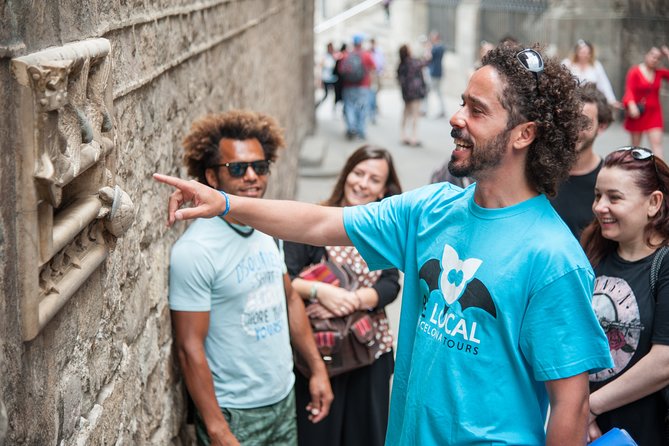
One of the standout stops is an old imperial burial site where you can see Roman outdoor tombs. This matters more than it might sound at first. Most people think they’re visiting “medieval Barcelona,” but the city’s story goes deeper—into Roman Barcino.
Later, you also encounter remains of the Barcino temple in a corner that’s easy to miss on your own. A guided walk is valuable here because the guide points out what you’d otherwise walk past without realizing you’re looking at a fragment of an ancient city.
A drawback to mention plainly: these are outdoor and in smaller spaces, so your comfort will depend on weather and your tolerance for slow walking in tight lanes. The tour is explicitly weather-dependent—good day streets make everything easier.
Churrerías street flavor: the Gothic Quarter beyond monuments
Not every stop has to be a cathedral or ruins. You’ll also spend time on one of the charming streets in the neighborhood, known for traditional churrerías and for details that reflect Barcelona’s past.
This is where I think a private format shines. You’re not just collecting landmarks; you’re getting a feel for what daily life looks like in a place most people experience only as a museum. If you’ve got food on your mind, the guide’s suggestions for pastry and chocolate-style stops can be a helpful next step after the tour.
Even if you’re not hunting sweets, I still recommend paying attention to the smaller storefront details. In the Gothic Quarter, history often shows up in the everyday stuff.
A Catalan Gothic church stop: why 14th-century details matter
The tour includes a wonderful 14th-century church described as a masterful example of Catalan Gothic architecture, right in the heart of the Gothic Quarter. When you’re walking, it’s easy to assume “Gothic” just means pointy arches. A good guide makes the differences feel practical—like you can spot why this is Catalan Gothic instead of guessing.
This kind of stop is useful on your first trip because it gives you a visual reference point. After you’ve seen what Catalan Gothic looks like up close, you’ll notice similar elements in other buildings across the neighborhood.
The one thing to keep in mind: churches tend to have rules about noise and sometimes dress. If you’re visiting in warm weather, plan for shoulders and respect the space.



Jewish Quarter alleys: medieval streets with a serious past
One major section of the walk goes through the old Jewish Quarter, an area of medieval alleys where a large Jewish community once lived. This is one of the stops where you benefit from hearing the story in sequence, because the neighborhood’s layout reflects shifting communities and power over time.
A good local guide also helps you avoid a common trap: treating it like a set of pretty lanes only. Even if the alleys look quiet now, you’re learning about what life once was here and why that mattered in broader Spanish and Catalan history.
For many first-time visitors, this is the emotional center of the tour—the place where the walking feels more than sightseeing.
Hidden square and Civil War scars: history you can see
Next comes a hidden square with a baroque church that has visible marks from bombings during the Spanish Civil War. This is one of the most sobering moments on the route, and I appreciate it when a tour doesn’t sugarcoat the past.
There’s also a contrast benefit for you as a visitor. After Roman tombs and medieval lanes, you get a modern layer of history—still part of the city’s physical surface. It turns the Gothic Quarter from “old stuff” into “real time layers.”
From a practical standpoint, this is a good stop to slow down. Squares like this give you a break from narrow streets and let you absorb what you’re seeing without constant walking.
Neo-Gothic bridge symbols: spotting meaning in odd details
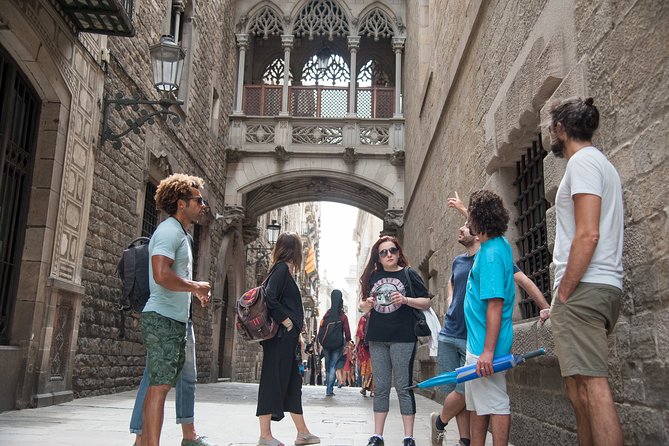
You’ll also see an elaborate neo-Gothic bridge famous for its spectacular design and its curious history of disturbing symbols. I like these kinds of stops because they train your eye. Once you’ve been shown what to look for—figures, motifs, symbolism—you start recognizing meaning in places you would otherwise treat as background.
If you’re traveling with teenagers or young adults, this is often the kind of stop that lands well. People tend to remember the weird, memorable, slightly creepy details long after the formal descriptions fade.
The only consideration: if your group is sensitive to heavy themes, give the guide a heads-up before you start so they can set the tone for your comfort level.
Catalonia’s power center: the medieval palace and civic squares
The walk includes an old medieval palace described as a symbol of the power of Barcelona in the past, now connected to the seat of the Government of the Autonomous region of Catalonia. That mix—old walls with modern governance—helps you understand that Barcelona’s “romantic” medieval image sits on top of real political life.
Then you reach a Gothic and neo-Gothic square where you can see the old Royal Palace of the Kings of Aragon and the Chapel of Santa Ágata. This is a strong architectural pairing: secular power nearby sacred space. When you see them together, the city’s political and religious priorities stop feeling separate.
If you like photo ops, this is one of the best areas to pause. It’s also a good moment to regroup before the final big church stop.
Santa Creu and Santa Eulalia: neo-Gothic façade over medieval structure
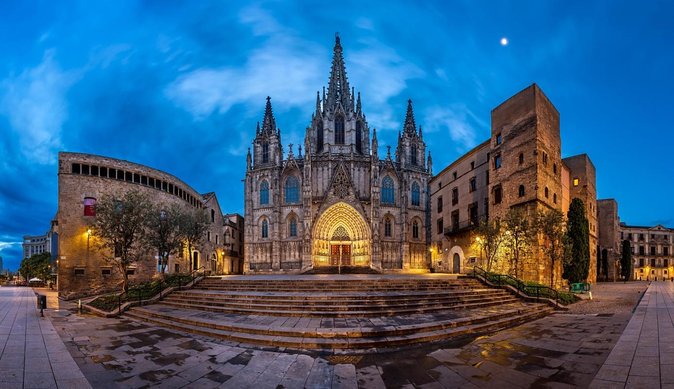
The tour ends at the Cathedral of Santa Creu and Santa Eulalia. It’s described as one of the most impressive churches in the city, with a splendid neo-Gothic façade set over a medieval structure, plus what’s essentially “thousand stories” worth of background.
This is your payoff stop. If you’ve followed along through Roman fragments, medieval alleys, Jewish Quarter lanes, and Civil War scars, the cathedral doesn’t feel random. It feels like the culmination of multiple eras shaping how Barcelona presents itself.
A practical note: cathedrals can be crowded at peak times, and your enjoyment depends on pacing and time spent looking. A private format helps here because you’re not stuck reacting to a group schedule.
Price and value: is $66.52 worth 2.5 hours?
At $66.52 per person for about 2 hours 30 minutes, this tour sits in the “high value if you care about context” category. Here’s why:
- You get an experienced local guide plus GST included.
- It’s a private tour, so you’re not sharing attention with strangers.
- Pickup is offered (within 0.5 km of Catalunya Square), which saves you time and confusion.
- You get a mobile ticket and group discounts (if you’re traveling with others).
What isn’t included is transport, but the tour is also described as near public transportation. Translation: you’ll still plan your own metro/bus/train, but you’re not relying on the operator to get you through the city.
Big value question: do you want more than a self-guided wander? If yes, this pays off fast in the Gothic Quarter, where it’s easy to see pretty streets without understanding what you’re actually looking at.
Who this private Gothic Quarter tour fits best
This tour is a great match if:
- It’s your first time in Barcelona old town and you want the city’s story in the right order.
- You enjoy history, but you also want it explained in a way that makes street corners click.
- You’re traveling as a family—guides have a track record of keeping kids engaged with playful, memorable bits (one family mentioned a kid-focused gag involving a poop log, which got the attention of both kids and adults).
- You want flexibility. A private format can adapt to walking pace, and one guest specifically noted accommodations for slower mobility.
It may be less ideal if:
- You dislike walking for extended periods or have trouble with uneven streets.
- You’re hoping for a fully inside-only experience. Much of the time is outdoor and street-level.
Booking check: should you choose this one?
Book it if you want a guided, English-language tour that turns the Gothic Quarter into a connected timeline—from Roman Barcino to neo-Gothic church façades—plus a few quieter spots people often miss. The guide-led storytelling, the private pace, and the mix of big sights with small details make this a strong first-day choice.
Skip it (or consider a different format) if you want a short, monument-only checklist with minimal walking. This is a walk-through-your-eye kind of tour, and that works best when you’re ready for streets, symbols, and layers.
FAQ
FAQ
How long is the Gothic Quarter private tour?
It runs for approximately 2 hours 30 minutes.
Is this tour private?
Yes. It’s a private tour/activity, meaning only your group participates.
Do you offer pickup?
Pickup is offered for travelers within 0.5 km of Catalunya Square. The guide carries a company card.
Where does the tour start and end?
The tour starts at Plaça de Catalunya, L’Eixample, 08002 Barcelona and ends at Pl. de Correus, Ciutat Vella, 08002 Barcelona (near Sant Jaume Square).
What language is the tour in?
The tour is offered in English.
Is transport included?
No. Transport is not included, though the tour is described as being near public transportation.
Can I cancel for a refund?
Yes. You can cancel for a full refund if you cancel at least 24 hours before the experience’s start time. Free cancellation is offered.
Is good weather required?
Yes. The experience requires good weather. If it’s canceled due to poor weather, you’ll be offered a different date or a full refund.