REVIEW · MADRID
Christmas Lights Tour of Madrid in Eco Tuk Tuk Private
Book on Viator →Operated by Eco Tuk Tuk - Spain · Bookable on Viator
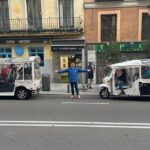
Madrid glows fast on a tuk tuk. In under an hour, this private Eco Tuk Tuk loop turns Madrid into a moving holiday postcard, with planned photo stops and a driver-guide who keeps the whole ride flowing.
I really like two things right away: the 100% electric tuk tuks (quiet, low-fuss) and the built-in comfort for winter, including blankets and rain/wind protective layers. It’s the kind of setup that lets you focus on the lights instead of the cold.
One thing to consider is that the route is fixed and you can’t add extra photo stops, so if you hate set itineraries (or you’re expecting a slow, stop-everywhere crawl), this may feel a bit more “efficient drive-by” than “linger and wander.”
In This Review
- Key highlights (what makes it worth your time)
- A 59-Minute Eco Tuk Tuk Christmas lights plan for Madrid
- Retiro meeting point, then straight into classic Madrid architecture
- Salamanca streets: Velázquez, Ortega y Gasset, Serrano in the glow
- Columbus square and Discovery Gardens: a scenic reset
- National Library of Spain (BNE): big, quiet, and impressive from outside
- Cibeles Fountain: the Madrid landmark that always pulls focus
- Palacio de Cibeles and the surrounding palace power zone
- Plaza de Canalejas and the Cortes: lions, stairs, and neoclassical drama
- Neptuno and Cibeles facing roles, then Prado-area art and the Jerónimos church
- Guides and navigation: what you should expect from the human part
- Price and logistics: does $47.77 feel fair?
- Comfort tips so your night doesn’t turn into a freeze test
- Who should book this Christmas Lights Eco Tuk Tuk tour
- Should you book the Eco Tuk Tuk Christmas Lights tour?
- FAQ
- Where does the Christmas Lights Tour of Madrid start and end?
- How long is the Eco Tuk Tuk private Christmas lights tour?
- Is this tour private, and what language is it offered in?
- Does the tour run in rain or heat?
- Can kids join the tour?
- Are pets allowed on the tour?
Key highlights (what makes it worth your time)
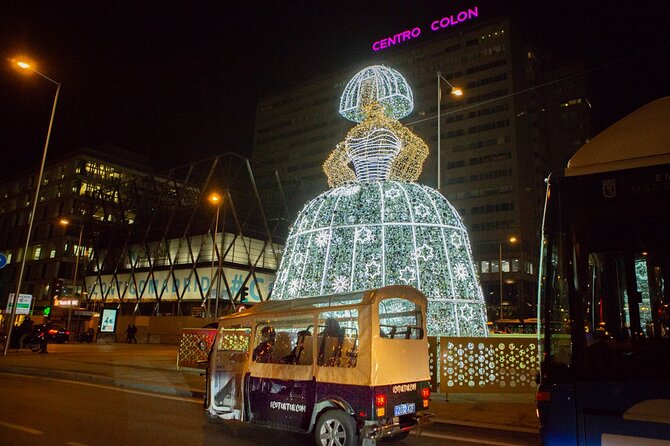
- Electric, 100% sustainable ride: less noise, less fuss, and a comfortable way to cover ground fast.
- Blankets and winter protection: practical gear for rain and wind, so your arms and legs don’t freeze.
- Queue-free start: you begin without the usual waiting around.
- Pre-selected photographing stops: you’re brought to the right corners for lights and landmarks.
- Big-name Madrid sights in under an hour: from Salamanca streets to Prado-area architecture.
- Private vehicle for your group: only your people in the tuk tuk(s), up to the legal passenger limit per vehicle.
A 59-Minute Eco Tuk Tuk Christmas lights plan for Madrid
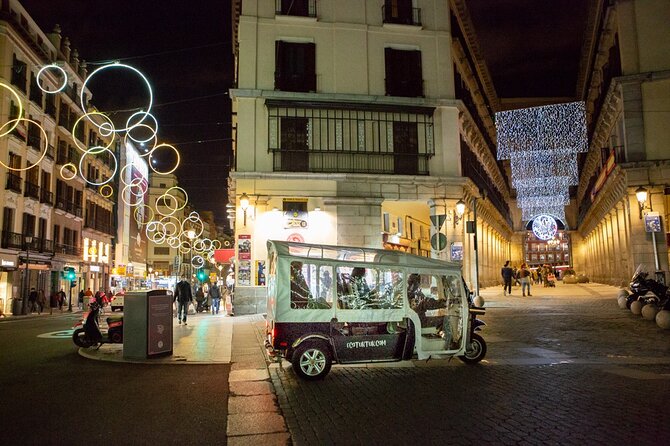
This is the right length if you want the lights without committing to a long night. At about 59 minutes, you get a compact circuit through some of Madrid’s most photogenic areas—perfect for your first evening, or for a quick family outing that doesn’t turn into an endurance test.
The ride is also smartly designed for comfort in colder weather. The tuk tuks come with protective layers against rain and wind and blankets to keep you warm while you’re holding your phone up for pictures.
And yes, you’re doing it in a private format. Your group rides in your own tuk tuk(s), and the setup is priced based on how many tuk tuks you need for your group (with the legal limit per tuk tuk). That matters because it keeps the experience feeling personal rather than like you’re squeezed into someone else’s schedule.
You can also read our reviews of more private tours in Madrid
Retiro meeting point, then straight into classic Madrid architecture
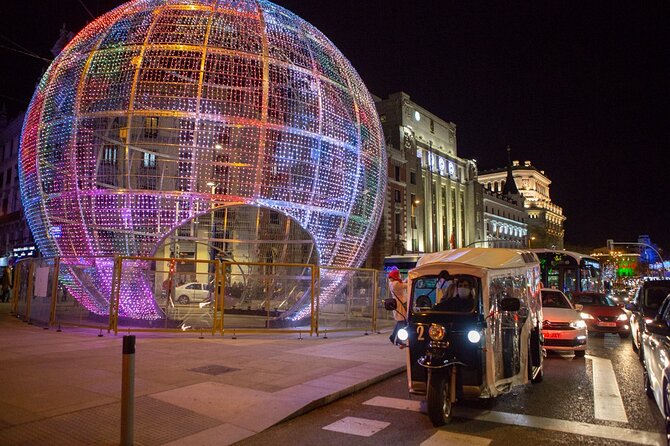
The tour starts at C. de Antonio Maura, 13, Retiro, and ends back at the same meeting point. That simplicity is more than convenience. It helps you avoid awkward “where do we meet later?” moments, especially when winter traffic and Christmas-week crowds can throw timing off.
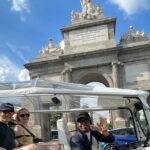
Very early on, you hit a monumental gate built under Carlos III. This one opened in 1778 and replaced an earlier 16th-century gate—so even before you reach the most famous Christmas-lit streets, you’re getting that sense of Madrid layering time on top of time.
What I like about starting here: the history is visual. You’re not just told facts—you’re seeing the size, the materials, and how the city’s older bones still shape where people move today. It also gives you a “sense of place” fast, which makes the next illuminated neighborhoods feel more meaningful.
Salamanca streets: Velázquez, Ortega y Gasset, Serrano in the glow
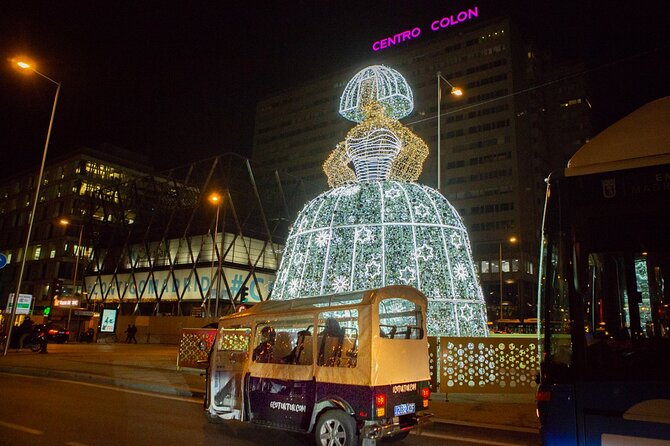
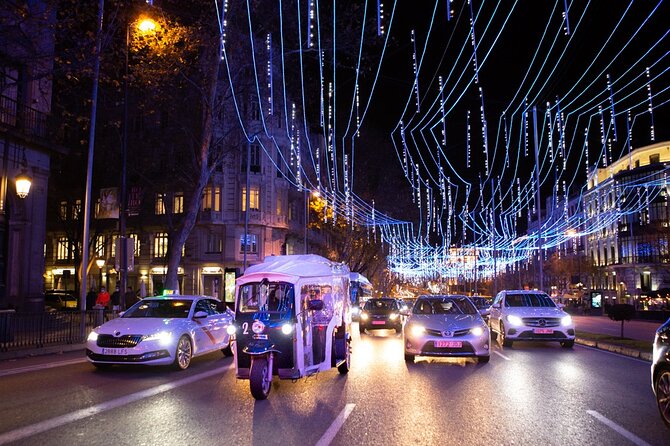
After the gate, the ride heads through the main streets of Salamanca—Velázquez, Ortega y Gasset, and Serrano. Salamanca is known for elegant boulevards, and at Christmas it turns into a clean, bright corridor for holiday lights.
This part works well because you’re covering several streets without stepping into the stop-and-start frustration of Madrid traffic on foot. A tuk tuk is basically built for this: you stay seated, you keep moving, and you get a steady view of façades and light displays as you pass.
Also, Salamanca’s streets are the type where the lights don’t just look pretty—they look organized, like someone planned the whole scene. If you like Christmas displays that feel polished rather than chaotic, this is the stretch that usually delivers.
Columbus square and Discovery Gardens: a scenic reset
Next up, you reach the Christopher Columbus monument—a neogothic white marble figure with a tall carved pedestal. The monument was built in 1885 by Jerónimo Suñol, and it presides over a square where traffic circles around its central fountain.
Nearby, the Discovery Gardens add a different vibe. These gardens opened in 1970, and they’re a place to admire sculptures connected to the theme of discovering America, including a monument dedicated to that story.
Then there’s an extra bonus texture that helps the stop feel more than just a photo moment: inside the area tied to Villa Fernán Gómez (in its basement level), there’s a Cultural Center. Even if you’re not going in, knowing it’s there gives you a sense of this area as active and civic—not just a landmark.
National Library of Spain (BNE): big, quiet, and impressive from outside
You also pass by the National Library of Spain (BNE), which is responsible for depositing and preserving Spain’s bibliographic and documentary heritage. The scale is mind-bending: it holds around 30 million publications produced in the national territory since the early 1700s, including books, maps, engravings, drawings, scores, and brochures.
What you’ll appreciate on a lights tour is how the library’s “serious” purpose contrasts with the season. It’s an elegant pause between holiday sparkle and civic architecture. Through the Library Museum and exhibition spaces (when those are operating), the collections and history are shared—so this isn’t just a building you glance at. It’s a functioning institution.
Since the tour is compact, think of this stop as a quick “aha moment.” You’ll see the exterior context and learn what the place does, which makes it feel more substantial than another quick streetlight photo.
A few more Madrid tours and experiences worth a look
Cibeles Fountain: the Madrid landmark that always pulls focus
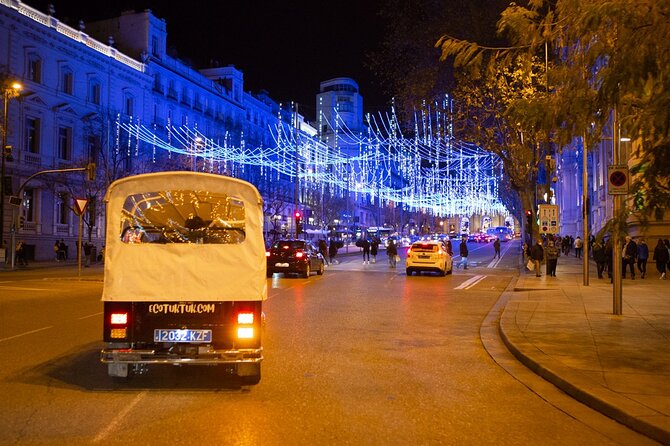
At Cibeles, the tour hits one of Madrid’s most iconic scenes. The fountain features the Roman goddess Cibeles riding a chariot pulled by two lions. The sculpture of the goddess is by Francisco Gutiérrez, while the lions are by Roberto Michel. It’s a major focal point because everything in the square orbits the monument visually.
Here’s where the stop gets fun beyond the lights: Cibeles is closely tied to Real Madrid celebrations. The fountain becomes part of the local ritual when titles are celebrated. So even if you’re not watching a game, you’re seeing a place that lives in Madrid’s sports culture.
If you care about getting memorable photos, this stop is usually a win because it’s wide, symmetrical, and bright. Even on a cloudy night, you can frame it without needing perfect weather.
Palacio de Cibeles and the surrounding palace power zone
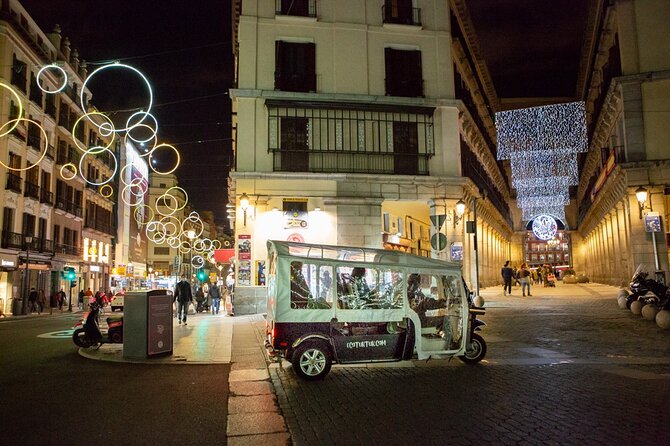
After Cibeles, the ride moves through an area lined with notable buildings, including Buenavista Palace (Army Headquarters), Linares Palace (America House), the Communications Palace (formerly the post office headquarters and now the Madrid City Council), and the Bank of Spain. That cluster matters because it gives you a sense of how the city concentrates power and administration in one visible grid.
You’ll also see Palacio de Cibeles, built as the headquarters for the Spanish Post and Telegraph Society. It opened in 1909, created by Antonio Palacios and Joaquín Otamendi, and later, in 1993, it was declared a Site of Cultural Interest.
Even if you never step inside, the building’s materials and design—stone, iron, and glass—tell a story about “old meets new” in an early-20th-century way. It’s a useful context stop on a Christmas lights tour because it shows Madrid isn’t only one mood. The lights are the moment; the architecture is the backbone.
There’s also the National Bank building nearby that’s described as intentionally decorative, built to match the importance of the bank’s role in Spain’s coin and bill issuance. It’s one of those exteriors you can appreciate faster than you can explain, which is perfect for a short night format.
Plaza de Canalejas and the Cortes: lions, stairs, and neoclassical drama
The ride also includes Plaza de Canalejas, a place formerly known as the Four Streets, located in Madrid’s Centro district. This is the kind of area where the lights feel like part of the street grid, not just decorations on a wall.
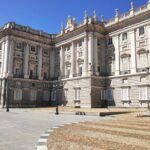
Then you get to the Palace of the Spanish Cortes (the Spanish Parliament building). This stop is all about façade details: a staircase rises to a neoclassical portico with six fluted Corinthian columns, topped by a triangular pediment decorated with reliefs by Ponciano Ponzano.
The entrance lions are tied to a very specific story. They were cast from iron from cannons captured during the African War, which gives the building’s symbolism a sharper edge than the usual stone-and-column look.
One practical note: the doors are only opened on special occasions. So don’t build your expectations around indoor access. Instead, treat this as a look-and-learn stop—close enough to feel the scale, informative enough to understand why the details matter.
Neptuno and Cibeles facing roles, then Prado-area art and the Jerónimos church
You’ll also see the Neptuno and Cibeles fountain relationship. The story here is about urban planning: in Ventura Rodríguez’s original concept, the fountains were facing each other along the Paseo del Prado. Later, at the end of the 19th century, both went through restructuring and were moved to occupy central positions in their current squares.
That “originals and relocations” story is actually great for a night tour. It turns what could be a quick pass into a mini lesson on how Madrid reshapes itself over time—without you needing to go anywhere else.
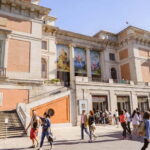
From there, you reach the Prado Museum area. The Prado is famous for European painting, and even seeing it from the outside helps you connect the dots: this is one of Madrid’s anchor institutions, and it’s right where you’d naturally want to be for a winter-evening walk someday.
Finally, you stop at San Jerónimo el Real, popularly called Los Jerónimos. It’s the Parish Church of San Jerónimo el Real, built in late Gothic style with Renaissance influences from the early 1500s. Even though little remains of the original building intact due to remodels and restorations, its long royal connection is clear: it was tied to the Catholic Monarchs and later became a place of spiritual retreat for monarchs. Over time, it was also used for royal investitures and major ceremonies like the wedding of Alfonso XIII, with the great staircase built in 1906.
On a Christmas lights tour, this last stop can feel like a soft landing: less about neon and more about atmosphere. If you want a night that mixes holiday brightness with real Madrid gravitas, this is a good ending point.
Guides and navigation: what you should expect from the human part
A lot of the value here comes from how the tour is handled in motion—timing, turns, finding the best angles, and explaining what you’re seeing while you ride.
The guides associated with this experience come up repeatedly by name in people’s feedback—Carlos, Ana, David, Christian, Laura, Alex, Arturo, Belén, Gloria. The common thread is clear: they help you see more than you would on your own walk, and they answer questions while navigating traffic and city streets.
So if you care about context—why a gate was built, what a fountain symbolizes, or why a building is designed the way it is—this kind of guided ride pays off. You get the highlights fast, with enough explanation to make the lights feel connected to place.
Price and logistics: does $47.77 feel fair?
At $47.77 per person for about 59 minutes, the “fairness” depends on what you’re trying to do.
If your goal is to see Christmas lights and major landmarks without spending hours on foot, it can feel like a good deal because you get:
- a private vehicle for your group,
- a 100% electric ride,
- queue-free start,
- planned photography stops, and
- winter protection (blankets, rain/wind layers).
Where it may not feel worth it is if you’re already the type who can easily walk the route, or if you’re going on a date when some lights are off. On Christmas Day specifically, some people found that a few light displays weren’t running. If your schedule lands on those peak holidays, it’s smart to keep expectations flexible.
Also, the vehicle comfort can be a mixed bag depending on your body type. One person noted that side bars in the tuk tuk design can land close to your face and make it harder to enjoy the view without adjusting position. If you’re picky about comfort for long pauses, sit in a way that keeps your line of sight clear.
Comfort tips so your night doesn’t turn into a freeze test
Even with blankets, you’ll be happier if you dress for standing outside at night.
Bring layers and gloves if you run cold. The tuk tuks provide winter protection, but you’ll still be looking outward and holding your phone up during photo moments. Wear shoes that handle a short, easy walk at stops.
If you’re traveling with kids, this format can work nicely because it’s short and controlled. People have specifically highlighted it as fun for children, with the guide keeping things lively while the tuk tuk handles the movement.
For older adults, the vehicles are described as suitable, and drivers will help them get on if needed. That’s important. Getting on smoothly reduces stress fast, especially in winter.
Who should book this Christmas Lights Eco Tuk Tuk tour
This tour is a strong match if you want:
- a fast introduction to Madrid’s most famous illuminated areas,
- a comfortable night outing with built-in winter gear,
- a guided route that helps you understand what you’re seeing in the moments you’re outside.
It also fits well for families, couples, and anyone who doesn’t want to fight traffic on foot. If you’re the type who loves planning long walking routes with lots of stops, you might feel less thrilled because the tour is designed around a fixed set of photographing places.
And if you’re traveling with pets, note that pets and companion animals aren’t allowed, though service animals are allowed.
Should you book the Eco Tuk Tuk Christmas Lights tour?
If you want a one-hour Christmas lights hit that mixes major landmarks, holiday atmosphere, and practical comfort, I think this is an easy yes. The combination of electric transport, blankets, and a private format makes it feel smoother than trying to “DIY” your way through lit-up Madrid in the dark.
Book it especially if it’s your first time in the city and you want to get your bearings fast, or if winter weather could slow your walking plans. If your main goal is maximum time stopping to photograph every street, this might feel a bit too structured.
My advice: treat it like a guided holiday highlights reel—and then, if something really grabs you (Prado-area streets, Cibeles, Salamanca boulevards), you’ll know exactly where to return for a slower look later.
FAQ
Where does the Christmas Lights Tour of Madrid start and end?
The tour starts at C. de Antonio Maura, 13, Retiro, 28014 Madrid, Spain and ends back at the same meeting point.
How long is the Eco Tuk Tuk private Christmas lights tour?
It runs for about 59 minutes.
Is this tour private, and what language is it offered in?
Yes, it’s a private tour/activity where only your group participates. It’s offered in English.
Does the tour run in rain or heat?
Yes. The tour takes place in rain or heat, and it can only be canceled under extreme conditions.
Can kids join the tour?
Most people can participate, but there are limits: the minimum age is two (2) years, and babies aren’t allowed. There is also a minimum weight requirement of 9 kg.
Are pets allowed on the tour?
No. Pets and companion animals aren’t allowed, but service animals are allowed.
If you want, tell me your travel dates and whether you’re going with kids or older adults, and I’ll help you decide if the timing (especially around big holidays) fits your expectations.