REVIEW · MADRID
Madrid Express Tour with Local Guide in Eco Tuk Tuk Private
Book on Viator →Operated by Eco Tuk Tuk - Spain · Bookable on Viator
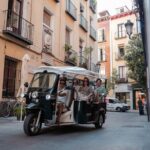
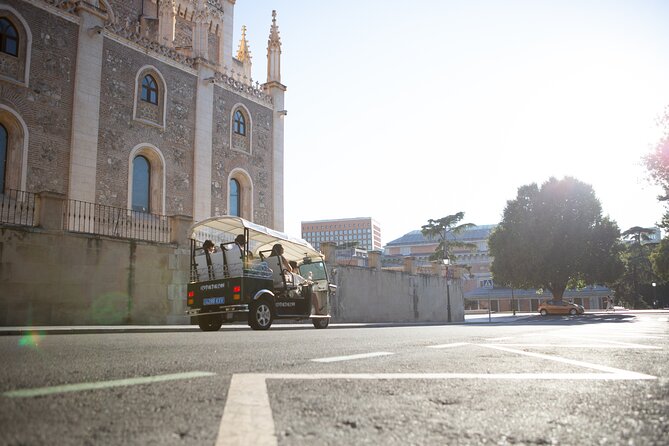
Electric tuk-tuks make Madrid click fast. This private eco-friendly ride is built for fast orientation, with a local guide pointing out what matters as you zip around central neighborhoods. In colder months, you get blankets and protective layers, so the tour still feels comfortable even when the city chills.
Two things I really like: the tour gets you moving right away, starting without queues or waiting, and it stays focused with pre-selected stops for photos instead of endless detours. I also love that it’s private, so you’re not stuck listening through other groups’ questions.
One thing to consider: the tuk-tuk’s shape can make it harder to look up at tall façades, and on very hot days you may feel the sun more than you would on foot or in a bus with full airflow.
In This Review
- Key highlights worth planning for
- The smartest way to use 1 to 4 hours in Madrid
- Finding the meet-up point near the Royal Palace (and not missing it)
- The express itinerary: photo stops that actually teach you the city
- Stop 1: A historic food market turned gastronomic address
- Stop 2: Atocha Station, Madrid’s busiest rail hub
- Stop 3: Palacio de las Cortes and the theater of government
- Stop 4: Neptune and Cibeles, Madrid’s rivalry in stone
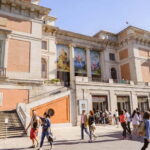
- Stop 5: The Prado area and why European painting is a big deal here
- Stop 6: San Jerónimo el Real (Los Jerónimos) next to the Prado
- Stop 7: Puerta de Alcalá, Madrid’s neoclassical triumph gate
- Stop 8: Palacio and grand civic surroundings, from Army HQ to the City Council
- Stop 9: Banco de España exterior, with a note about what you can’t do
- Stop 10: Plaza de Santa Ana, a living square in the Cortes area
- Stop 11: Almudena Cathedral and Pope John Paul II’s consecration
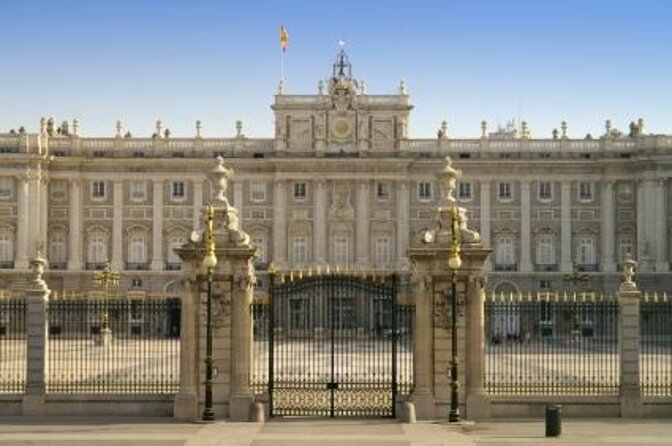
- Stop 12: Palacio de Oriente, Madrid’s working royal stage
- Comfort, weather, and what your camera may struggle with
- Price and value: why $28.67 can make sense
- Who this tuk-tuk tour is best for (and who should skip it)
- Should you book Eco Tuk Tuk Madrid Express?
- FAQ
- How long is the Madrid Express Eco Tuk Tuk tour?
- Is the tour private?
- What sights do you stop at during the tour?
- Is the tour in English?
- What should I know about weather and comfort?
- Are there age or size requirements?
Key highlights worth planning for
- Electric and private: 100% electric tuk-tuks reserved just for your group, with a legal max of 4 passengers per vehicle
- No queue start: you begin without waiting, which is huge if you only have a day or two
- Winter comfort kit: blankets and protective layers for rain, wind, and cold
- Photo-stop routing: planned exterior stops mean you see the big buildings without hunting for them
- Local guiding style: guides like Juan, Esther, Carlos, and Fernando are praised for clear English and practical history
The smartest way to use 1 to 4 hours in Madrid
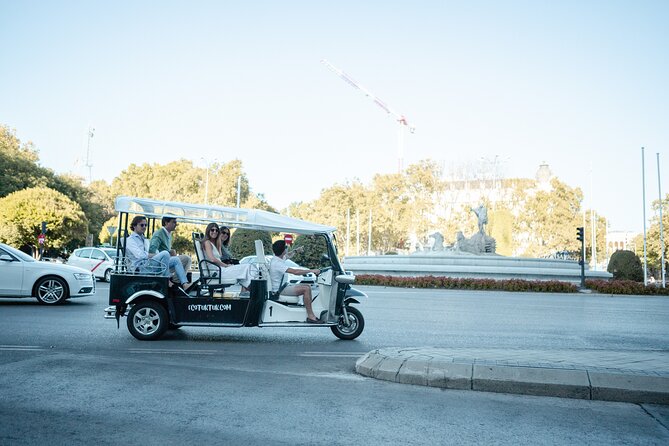
If you’re trying to understand Madrid quickly, this format works. A tuk-tuk gives you enough speed to cover ground, but you still stop at the right places to absorb the details and ask questions.
I like that the ride feels intentionally “express.” You’re not being rushed through museum hallways or forced into long entries; instead, you get key sights plus real street-level context as your guide narrates what you’re seeing.
You’ll also feel the “first day” logic behind the route. It puts you near the core monuments and civic landmarks, so later, when you pick a neighborhood to explore on your own, you’ll already know what’s where and why it matters.
You can also read our reviews of more guided tours in Madrid

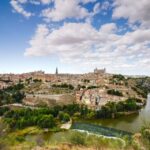
Finding the meet-up point near the Royal Palace (and not missing it)

Meet here: C. de Bailén, 4, Centro, 28013 Madrid. The practical detail is that the pickup is at the bus station (underground) of Plaza de Oriente, right by the Royal Palace, beside the Prince’s Gate.
The listing’s directions are very specific because Calle Bailén 4 can be confusing on maps. What works in real life: search for Calle Bailén 4 or Puerta del Príncipe in Google Maps, then look for the stairs to the station across from the Prince’s Gate and follow the Eco Tuk Tuk signage.
Bring your eyes and your phone. You’ll have a mobile ticket, and because the tour starts on time, arriving late can cut into your route. If you’re running behind, contact them by phone or WhatsApp right away.
The express itinerary: photo stops that actually teach you the city
This tour is built around exterior viewpoints and short stops, so each location works like a chapter. You’ll move from food and transport to politics, art, churches, and royal power, with guidance that connects the dots.
Expect the timing to feel “jam packed.” If you book the shorter option, you’ll likely see fewer stops and spend more time at the most photogenic façades. If you pick a longer option (up to about 4 hours), you’ll get more of the route and slightly more breathing room between areas.
It’s also worth knowing the route can shift due to closed streets or demonstrations on the day. When that happens, the theme stays the same even if a specific stop gets adjusted.
Stop 1: A historic food market turned gastronomic address
You’ll start with a market that dates back to May 1916, later reshaping itself into Madrid’s first gastronomic market in 2009. The key idea here isn’t to eat on the spot; it’s to get the “Madrid runs on food culture” context early.
Why it’s a good first stop: a guide can set the tone for the neighborhoods around central Madrid. You learn how modern Madrid layers over older functions, like a city that updates its identity without losing the plot.
Practical note: this stop works best if you’re willing to look at the building and take in the vibe from the outside, since the tour is focused on moving and photographing rather than staying inside.
Stop 2: Atocha Station, Madrid’s busiest rail hub
Next comes Atocha station, a massive railway complex near Plaza del Emperador Carlos V. It’s described as the country’s busiest station and one of the busiest in Europe, and your guide will frame it as a key entry point to the city.
This stop is useful even if you don’t travel by train. It teaches you how Madrid connects: arriving here means you’re in the center of the network, not on the edge of town.
You might find this stop especially helpful if you’re planning your own day trips. Once you understand Atocha’s role, it’s easier to map where your time can expand beyond central Madrid.
You can also read our reviews of more private tours in Madrid



Stop 3: Palacio de las Cortes and the theater of government
Then you’ll head toward the Palace of the Spanish Courts, built on the former convent of the Holy Spirit, which served as the seat of Congress in the 1800s. The façade details matter here, and the guide’s job is to point out what you’d otherwise miss.
One of the standout visual stories: the lions flanking the entrance were cast using iron from cannons captured during the war in Africa. That kind of detail turns a government building into a living reminder of Spain’s changing eras.
You’ll also hear about how certain doors only open on very marked occasions. In other words, you’re not touring the political interior here, but you’re learning how the building signals importance.
Stop 4: Neptune and Cibeles, Madrid’s rivalry in stone
From there, you’ll get to the twin mythology story that helps explain Madrid’s sports culture. You’ll see the relationship between Cibeles and Neptune, including how they ended up at the center of Plaza de Cibeles and Plaza de Cánovas del Castillo, respectively.
The guide usually ties it to what you’ll notice on match days: Atlético supporters celebrate at Cibeles, Real Madrid titles get marked at the Neptune-side area. It sounds like fun trivia, but it also shows how Madrid uses public space for identity.
If you like street photography, this is a strong zone. The plazas give you perspective lines, and the fountains are easy landmarks to circle later on your own.
Stop 5: The Prado area and why European painting is a big deal here
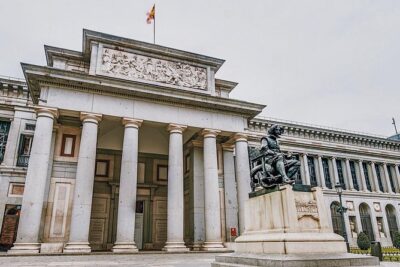
You’ll pass through the orbit of the Prado Museum, widely described as one of the most important places in the world for European painting. Your guide will highlight a practical takeaway: this is where you understand major artists and how Spain fits into European art history.
When you hear names like Velázquez, El Greco, and Goya, it helps to remember that these aren’t random famous paintings. They represent different approaches, different eras, and different ways Spain expressed power, faith, and daily life.
Even if you’re not entering the museum today, this stop gives you a mental anchor. Later, when you see the Prado listed as a must, you’ll know what you’re going for.
Stop 6: San Jerónimo el Real (Los Jerónimos) next to the Prado
Close by is the church popularly known as Los Jerónimos. Its official name is the Parish Church of San Jerónimo el Real, and it’s late Gothic with Renaissance influences from the early 1500s.
Why this stop lands: it adds a different layer than the museums and monuments. You get the “religion and royal ceremony” Madrid alongside “art and civic power,” all within walking distance of each other.
Also, you learn the building has been remodeled and restored multiple times. That makes it feel less like a frozen postcard and more like a real structure that survived centuries of change.
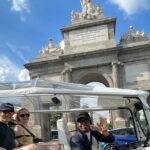
Stop 7: Puerta de Alcalá, Madrid’s neoclassical triumph gate
Then comes Puerta de Alcalá, commissioned by Carlos III to replace an earlier 16th-century gate. Designed by Francesco Sabatini, it’s a neoclassical arc of triumph often compared as a precursor to other famous European triumph gates.
This is one of my favorite types of tour stops because you can see the design logic from street level. Your guide can walk you through how the inner and outer sides differ in decoration, which changes what you notice depending on which angle you take.
Look for the four virtues described in the story: Prudence, Justice, Temperance, and Fortress. They’re the kind of symbolism your eyes might skip on their own unless someone points them out.
Stop 8: Palacio and grand civic surroundings, from Army HQ to the City Council
As you move through the next stretch, you’ll be shown the monumental cluster around Palacio de Buenavista (Army Headquarters), Palacio de Linares (Casa de América), and Palacio de Comunicaciones (the former post office, now the City Council).
This segment helps you understand Madrid as an administrative capital, not only a sightseeing capital. You’ll see the scale and the planning behind the streets, and that makes the whole city feel more coherent.
It also gives you a practical benefit: once you’ve seen this zone from the ride, navigating later on foot becomes much easier.
Stop 9: Banco de España exterior, with a note about what you can’t do
You’ll pass by the Banco de España, a building designed to match the importance of its banking role, including issuance of coins and bills across Spain. The exterior is a lesson in how institutions display authority.
One caution your guide may mention: the interior is not generally open to the public. It can only be visited by groups from educational centers and universities, with exceptional access for certain non-profit cultural entities.
So if you were hoping for a quick interior look, set expectations now. This tour is about seeing the outside properly and learning why the building was made and how it fits the skyline.
Stop 10: Plaza de Santa Ana, a living square in the Cortes area
Next is Plaza de Santa Ana, an open space that dates back to 1810 and has changed shape over time through multiple urbanization efforts. This is a nice contrast after all the monumental architecture.
If you’re a photography person, squares like this help you capture real Madrid life. If you’re not, it still works as a mental reset between big civic buildings.
It’s one of those places where you can later pick a café and decide what you want from Madrid: museums, people watching, or both.
Stop 11: Almudena Cathedral and Pope John Paul II’s consecration
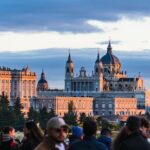
You’ll then reach Almudena Cathedral, described as the most important religious building in Madrid. It was consecrated on June 15, 1993, by Pope John Paul II, and it became the first consecrated cathedral outside Rome.
Even if you don’t go inside, the stop gives you context. A guide can connect the cathedral’s importance to modern Madrid, not only medieval or early modern Spain.
If you’re planning a separate cathedral visit later, this stop helps you orient quickly and decide whether you want more time.
Stop 12: Palacio de Oriente, Madrid’s working royal stage
Finally, you’ll move around the Royal Palace area, also called Palacio de Oriente. Construction began in 1738, with works lasting about 17 years, and Carlos III established it as a habitual residence in 1764.
The big practical value: you learn how the palace relates to what was there before, since the location replaced the Palace of the Austrias destroyed in a Christmas Eve fire in 1734. That kind of story makes the building feel less like a prop and more like the outcome of real events.
You’ll also hear how the palace connects to Campo del Moro gardens and Sabatini gardens, with Campo del Moro mentioned as day-visit friendly. Even if you don’t walk in today, you’ll know exactly where to go later.
Comfort, weather, and what your camera may struggle with
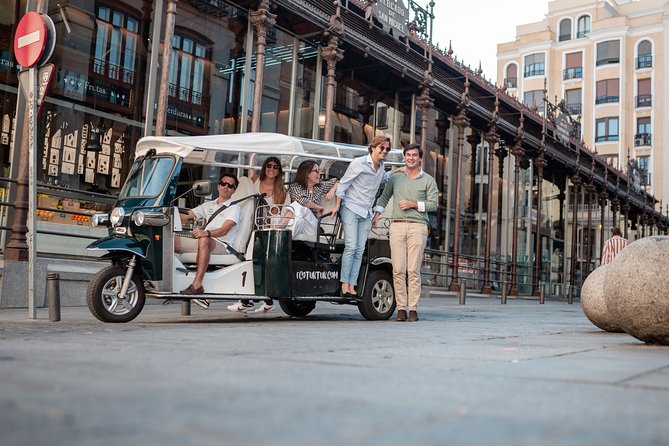
Madrid weather changes fast, and this tour runs in rain or heat. What you get in winter is practical: blankets and protective layers against rain and wind, which is a major help on open-air vehicles.
That said, one review-style caution matters: the top of the tuk-tuk can make it tricky to look up at tall façades. If you want full-height photos of big buildings, you might need to angle your body and position carefully during stops.
On very hot days, you may feel less comfortable than you would on a shaded bus or on foot with breaks. If you’re booking in midsummer, I’d plan extra water and expect that the ride is more “close and sunny” than “cool and breezy.”
Price and value: why $28.67 can make sense
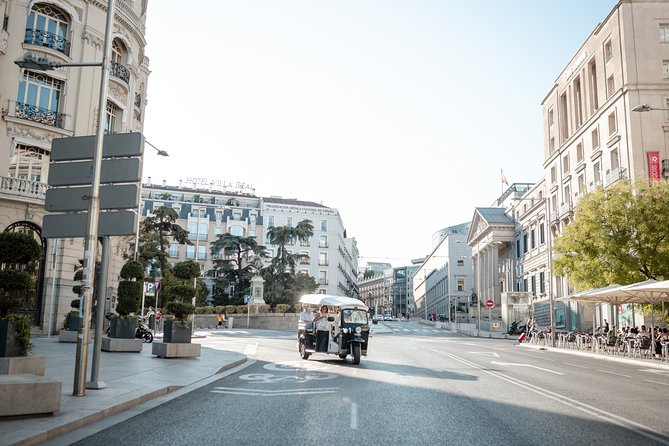
At $28.67 per person, this tour is priced like an express intro, not like a full day of private guiding plus museum tickets. The value comes from three things: time saved, a focused route, and the private vehicle experience.
Starting without queues or waiting is meaningful. In a city where time can evaporate fast, that’s part of what you pay for.
The other value piece is that stops are pre-selected. You’re not stuck wondering where to go next. Your guide’s job is to make each exterior stop count, which helps if you only have one short block of time.
The one nuance: tuk-tuks are reserved privately, and the cost is set according to how many tuk-tuks you need for your group, up to 4 passengers per tuk-tuk. If you’re traveling as a family or small group, it can still be a strong deal because you avoid the mismatch of mixing with strangers.
Who this tuk-tuk tour is best for (and who should skip it)
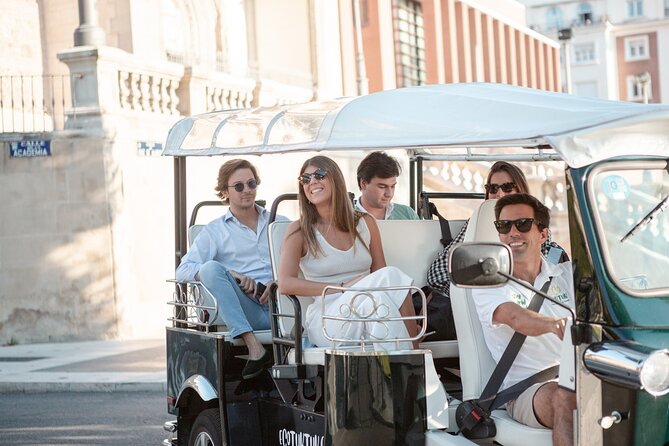
I think this tour fits you if you want a fast, friendly orientation with a guide who can explain what you’re seeing while you ride. It’s especially good after an overnight flight or if your schedule is tight and you’d rather get the big picture than plan 10 separate entrances.
It also works well for families, since the ride format and guides’ interaction style are designed for comfort in real-life conditions, including cold and rain.
Skip it if your priority is interior access. This is mainly an exterior-and-context tour, and places like the Banco de España interior and many museums are not the point here.
Should you book Eco Tuk Tuk Madrid Express?
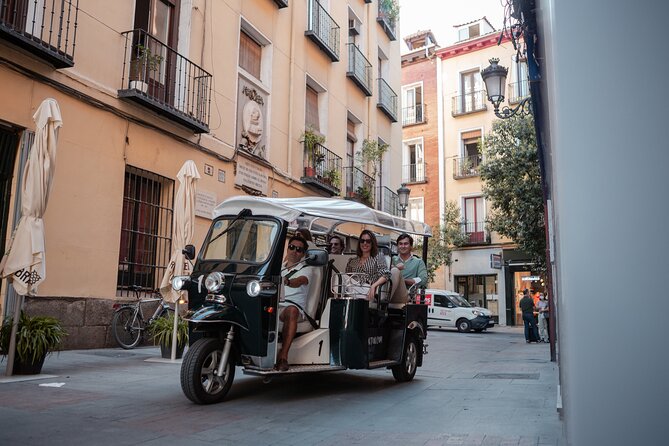
If you’re asking, Should I book this or just walk the center, I’d answer with a simple test. If you only have about 1 to 2 hours, and you want quick orientation plus photo stops, booking makes sense.
If you’re the type who enjoys being shown the small details, you’ll also like this approach. Guides like Juan, Esther, and Carlos are praised for clear English and for answering questions in a way that feels practical rather than lecture-style.
If you’re visiting in extreme heat or you’re very picky about tall-building views, plan for that. Bring expectations about how visibility works from the tuk-tuk, and use the stops where the best angles are.
Overall, this is a smart way to get Madrid’s big landmarks into your mental map fast, while keeping the ride comfortable with eco tech and winter layers when you need them.
FAQ
How long is the Madrid Express Eco Tuk Tuk tour?
The tour duration is listed as approximately 1 to 4 hours, depending on the option you choose.
Is the tour private?
Yes. It’s a private tour/activity, and only your group participates.
What sights do you stop at during the tour?
The route includes photo stops at central landmarks and areas such as a historic gastronomic market, Atocha station, the Palace of the Spanish Courts, Plaza de Cibeles/Neptune area, the Prado area, San Jerónimo el Real (Los Jerónimos), Puerta de Alcalá, Plaza de Santa Ana, Almudena Cathedral, and the Royal Palace area.
Is the tour in English?
Yes, it is offered in English.
What should I know about weather and comfort?
The tour operates in rain or heat. In cold weather, you’re provided with blankets and protective layers against rain and wind.
Are there age or size requirements?
Yes. The minimum age is 2 years, and babies are not allowed. There is also a minimum weight requirement of 9 kg. Pets are not allowed.